
Group Room Acquisition
Group-Event & Party Room Customer Acquisition and Productized Operations Guide
How digital sports venues convert group-event and party rooms from "empty space" to "steady revenue": why foot traffic alone never fills group rooms, B-side vs C-side acquisition channels, three-tier product packaging (Basic / Advanced / Premium), bundling add-ons, showcase materials, conversion scripting, repeat-purchase and referral systems, review reputation operations, seasonal rhythm, and a data-driven operations dashboard.
Many digital sports venues install group and party rooms only to face an awkward reality: walk-ins come and go, but the group room stays empty. This is not because no one wants to book a private event — it is because event customers have a completely different acquisition logic than walk-ins. Walk-ins arrive by foot, by short-video ads, by searching "fun things near me" on review platforms. Event customers arrive through corporate HR groups, parent-to-parent birthday threads, or referrals from local team-building planners. Walk-in traffic simply does not spill over into group rooms.
This guide starts with why walk-in traffic never works, then walks through B-side and C-side acquisition channel matrices, three-tier product packaging, add-ons, showcase materials, conversion scripting upgrades, repeat-purchase systems and seasonal rhythms, and closes with a data-driven operations dashboard framework. It is not generic advice to "run more ads" — it is a hands-on checklist for taking a group room from zero to ten bookings a month. Group-event rooms follow a complete chain from design to profitability: space design is the starting point, pricing and packages determine the average spend, customer acquisition and productized operations determine order volume, and on-the-ground execution determines repeat business — this four-guide series covers the entire journey.
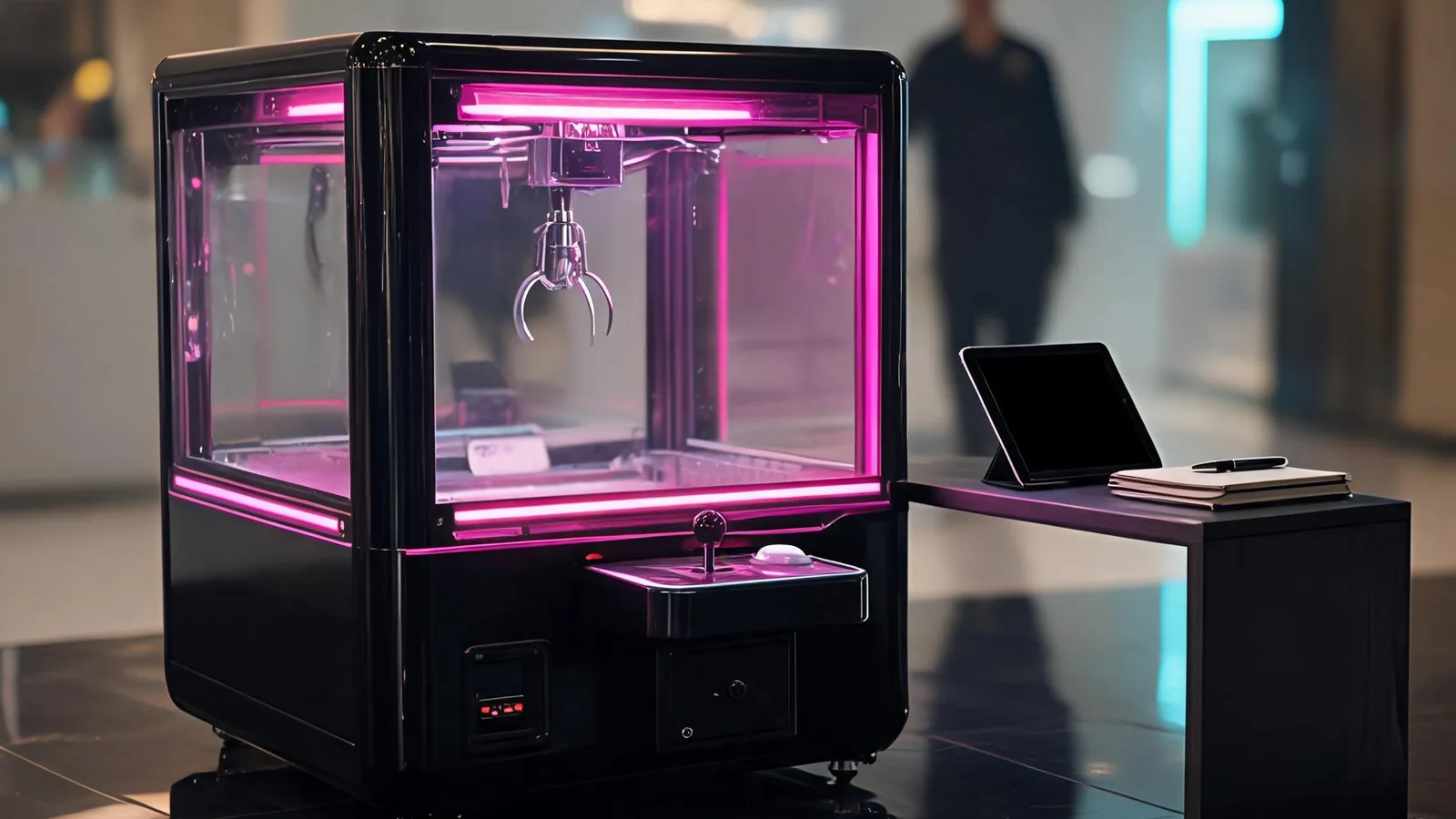
Why Walk-in Traffic Never Fills Group Rooms: Two Completely Different Acquisition Logics
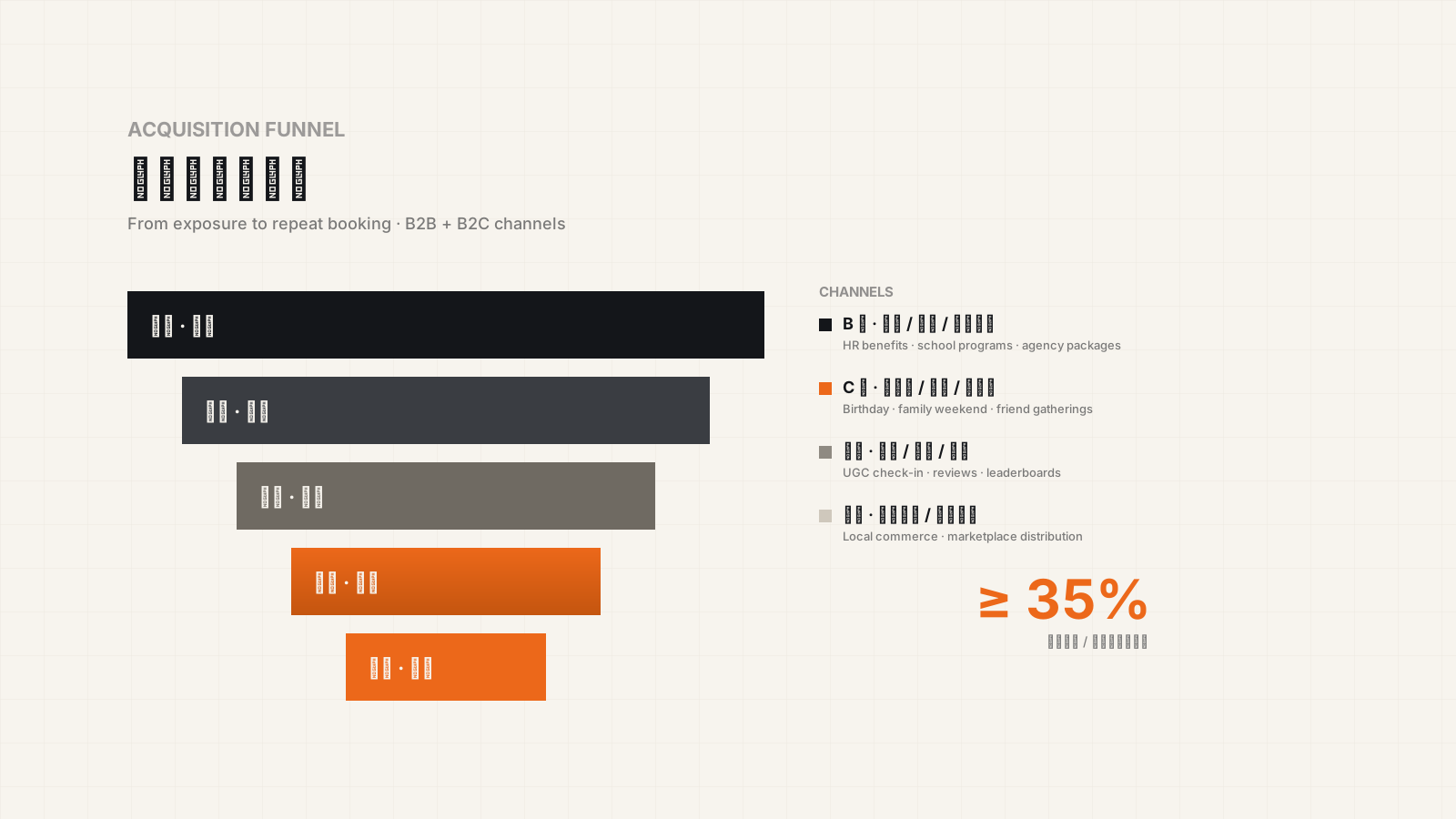
Walk-in customers and event customers follow **different decision paths**. Walk-ins are "buying a ticket" — search nearby, read reviews, purchase, arrive. Event customers are "planning an event" — the team-building organizer first asks admin; the birthday parent first asks neighbors; the private-booker first searches "event venues in District X". A walk-in decides alone. An event may require company approval, family discussion, or multiple-site comparison. When you run a "50% off grand opening" coupon on the review platform, walk-ins click it. Event customers do not even glance at it.
**Search keywords are completely different**. Walk-ins search for "digital sports", "fun experience", "what to do this weekend". Event customers search for "team-building venue", "birthday party space", "private event venue District X", "indoor event for 30 people". If the venue only targets "digital sports", event customers will never find you. Split keywords into two groups and run both: "digital sports + play" covers walk-ins, while "digital sports + host an event" covers group bookings.
**Showcase content is also different**. Walk-ins want to know "what equipment, how much per person, what rating". Event customers want to know "max capacity, minimum hours, can we bring our own cake, how does team-building work, are there ready-made programs". If your review page only shows equipment photos and walk-in pricing, event customers will scroll past. Build a dedicated **group room section**: real venue photos, past event galleries, package descriptions, and FAQs — a parallel content set separate from the walk-in area.
- Decision paths differ: walk-ins buy alone; events involve company approval or group comparison
- Keywords split two ways: digital sports + play / digital sports + host an event
- Showcase two content sets: walk-ins see gear and price; events see capacity and programs
B-side Channel Depth: Corporate HR Groups, Campus Operators, and Team-Building Planner Referrals
The core of B-side acquisition is **getting on corporate procurement radar**. Three most effective channels: **corporate HR groups** (admin and HR groups at local internet companies, tech parks, and manufacturers — HRs routinely refer team-building vendors to each other. Join groups by posting useful content, not hard ads: "Our newly renovated digital sports venue supports a six-team rotation format — finish in two hours with live scores". **Campus operators** (tech parks and industrial zone operators have an obligation to recommend event venues to their tenants. Propose "you refer us, we give your tenants exclusive discounts"). **Team-building planner referrals** (planners have no venue, you have no planning — cross-refer with commission. Industry standard: 15-20% for first booking, 10% for repeat).
B-side **cold start depends on case studies**. No case studies yet? Find a small company you know. Run one team-building event for free or at cost. Deliver three items afterward (photos, score data, one-page recap). Ask for an anonymized testimonial (industry, headcount, activity, feedback). Post it on your website and sales materials. One real testimonial is a hundred times more credible than saying "we are professional".
**B-side channels need a dedicated person**. Do not let front desk staff double as B-side sales — front desk is swamped with walk-ins and will never nurture HR-group relationships. Founder runs it at first; once steady, hire a "Group Room Sales Lead" whose job is solely B-side outreach, proposal writing, and enterprise follow-ups. B-side customers have far higher repeat rates than walk-ins. One retained annual-framework client delivers five to ten stable bookings a year.
- Three B-side channels: HR-group content + campus-operator cross-promotion + planner commissions
- Cold start with case studies: run one free for a known company, exchange for anonymized testimonial
- Dedicated B-side staff: repeat rates far higher than walk-ins; one annual framework = five walk-in orders
C-side Channel Matrix: Meituan-Dianping Keywords, Local KOLs, and K-12 School Neighborhoods
The C-side battleground is **Meituan-Dianping and Xiaohongshu/Douyin**. On Meituan-Dianping, besides generic terms like "digital sports" and "fun", you must target **long-tail buyout keywords**: "birthday party venue District X", "family birthday District X", "team-building venue District X", "indoor event for 30 people". These have low search volume but high intent — the searcher has already decided "we are hosting an event" and is now comparing venues. Rename your group-buy packages directly to "Birthday Party Exclusive Package" and "Team-Building Exclusive Package". Conversion rates are much higher than generic "digital sports open play".
Run **local KOL targeted campaigns** on Xiaohongshu and Douyin. Skip the million-follower influencers. Target local "parenting bloggers" and "local lifestyle bloggers" with 10k-50k followers — their audiences are precise. One geotagged post brings twenty to thirty inquiries. Content is not a hard ad: "Last weekend I picked a digital sports venue for my kid's birthday — kids went crazy for two hours", with six to eight photos and a natural mention at the end: "You can search for the digital sports venue in District X".
**Leaflet distribution around kindergartens and primary schools** is the oldest and most effective birthday-party acquisition tactic. During back-to-school seasons and birthday peak months (Feb-Mar, May-Jun, Sep-Oct), distribute coupons for "free birthday party photo session" or "free birthday decor upgrade" at school pickup points. Coupons include venue photos and a simple package description. Parents receive it while picking up kids, discuss with their children at home — conversion rates beat online ads. Wear venue uniforms so parents immediately recognize you as a legitimate venue.
- Meituan-Dianping long-tail: District X birthday / District X team-building / venue for N people
- Local KOL 10k-50k followers: parenting + lifestyle bloggers posting real experiences
- School-neighborhood leaflets: birthday coupons work best in back-to-school and peak months
Three-Tier Product Packaging: Basic, Advanced, Premium — Transparent Pricing
The core of productization is **not making customers piece things together themselves**. A common mistake young venues make: a customer asks "I want to book a private event" and the venue replies "how many people, how many hours, which equipment, let me calculate". The customer does not even know what they want. By the time you finish calculating, they have booked elsewhere. Productization means replacing the walk-in "buy tickets separately" logic with a group-booking "choose a package directly" logic.
Three tiers work best: **Basic** (15-20 people, 2 hours, fixed equipment combo, no decor no catering, rock-bottom price) — for small department team-building and low-budget birthdays. Transparent price, fast decision. **Advanced** (25-40 people, 3 hours, fixed equipment combo + two optional theme decors + light catering + 1 on-site coordinator) — for mid-sized team-building and standard birthdays. This is the **flagship package** — 80% of group bookings choose this tier. **Premium** (50+ people, 4+ hours, all equipment open + custom decor + full catering + photography & video + award ceremony + dedicated account manager) — for annual parties, brand pop-ups, and large gatherings. High margin but low volume.
Every tier must display **transparent pricing**: what is included, what is not (extra person surcharge, overtime rate, damage liability), printed on quotes and posted on the website so customers read it at a glance. Never "quote based on the customer" — enterprise clients compare quotes, and any inconsistency gets you eliminated. Parents cross-check review sites for pricing differences. Transparent pricing is not low-price competition; it is the most direct way to build trust.
- Three tiers: Basic 15-20 / Advanced 25-40 flagship / Premium 50+
- Productization = no piecing together: choose a package and decide faster than walk-ins
- Transparent pricing, never variable by customer — the fastest trust-builder
Add-on Bundling: Turn Low-Marginal-Cost Items into Profit Pillars
Items "not included" in the three tiers are the **source of add-on services**. Core principle: "low marginal cost, high customer perception". Adding a photographer needs no extra venue space. Adding a cake only requires two hours advance notice. Adding a team-building coach only means scheduling. Add these to packages and the average order value rises 30-50% — but the venue's extra cost is only 5-10%.
Five highest-value add-ons: **team-building coach / host** (needed when enterprise team-building is run as a competition to open, group, moderate, and award. Coach is on-site staff working a side role — cost near zero). **Photography & video** (use venue equipment or partner photographers, charge by package duration, deliver within 24 hours after the event). **Cake & decor** (birthday-party essential. Partner with a nearby bakery for bulk discounts. Venue does not stock cakes — only coordinates timing and placement). **Light catering & drinks** (pre-packaged food and simple coffee/tea, charge by headcount, prepare two hours ahead). **Gifts & trophies** (enterprise team-building awards. Pre-negotiate spot prices with suppliers — order only when booked).
Price add-ons **anchored to the main package**: Basic tier gets an "optional add-on list"; Advanced tier gets "buy one get one" or "limited-time free" on selected add-ons (e.g., "Advanced tier includes one free hour of photography"); Premium tier includes all add-ons by default. Never let customers pick a single add-on standalone — that circles back to the piecing-together model. Guide customers to "choose a package + add one or two extras". Average order value is much higher than buying everything separately.
- Five high-value add-ons: coach, photography, cake, light catering, trophies
- Marginal cost near zero but average order value up 30-50%
- Pricing anchored to tier: Basic optional / Advanced partial-free / Premium all-inclusive
Showcase Materials: Real Room Photos, 360 Video, Event Case Studies, Testimonials
Event customers must **"see" the venue** before booking — one blurry front-desk photo is not enough, nor are equipment photos alone. Showcase materials aim to make the customer feel "already standing in the room". Four most effective items: **real room photos** (12-15 shots each of the group room styled as "team-building just ended" and "birthday party just ended" — wide shots, activity zone, lounge zone, photo wall, equipment close-ups); **360 video** (shoot with a phone, pan the room, post to social media and Meituan-Dianping — customers swipe to see the whole space); **past event case studies** (anonymized, one page per case: client industry, headcount, event theme, 6-8 photos, one-sentence client feedback); **testimonials** (five to ten, covering enterprise, birthday, and general group-bookings, with client name or company initials).
Showcase materials must live **everywhere customers look**: dedicated group room page on the website, Meituan-Dianping "Group Buys" and "Vendor Album", Xiaohongshu/Douyin account, sales quote attachments, freestanding display at venue front desk. Do not bury them in internal systems — if customers cannot find them, they do not exist. After each event, with permission, reuse nice photos from the customer's social posts for the next case study. Accumulated over time, this is a free showcase library.
The **update cadence** is "one new case study every five bookings". Do not post the same case studies all year — customers will think "has this venue not hosted anything lately?". Update frequency itself signals "this venue is busy". Real room photos can swap decor every two months (different backdrop colors, florals, table accents). 360 videos can be reshot every quarter to keep freshness.
- Four core items: real room photos + 360 video + anonymized case studies + testimonials
- Post everywhere customers look: website, review platforms, social, quotes, front desk
- Update cadence: new case every five bookings, room decor swap every two months
Conversion Script Upgrade: From "We Have a Hall" to "We Run a Mature Six-Team Rotation Format"
Conversion scripting is fundamentally **shifting from "what I have" to "what you get"**. New venues often say "we have a large group room, lots of equipment, we host private events" — this is "what I have". Customers hear a list of adjectives with no picture. The upgraded script: "We run a mature six-team rotation format, finish in two hours, auto-generate scores and rankings, deliver photos and a one-page recap within 24 hours" — this is "what you get". Customers hear a **complete event flow** and immediately think "I can just form six departments".
Three key scripting moves: **be specific, not adjective-based** ("finish in two hours" is more credible than "fast"; "auto-generated scores" beats "we score"; "24-hour recap" beats "we'll share materials later"); **replace "what I can do" with "what the last client got"** ("the last company got six photos and a one-page recap" beats "I can give you photos and a recap"); **avoid vague elastic words** — replace "about two hours", "should fit", "possibly" with "exactly two hours", "max thirty people", "confirmed yes".
Scripts must be **written into a standard document and followed by everyone**. Do not let each salesperson ad-lib — one says "we have a big room", another says "we have great equipment", customers get inconsistent information. The most effective approach is a one-page "Group Room Sales Script Checklist" that sales, front desk, and on-site staff all memorize and follow during inquiries. Update it regularly — after every ten bookings, summarize the top three customer questions and add the answers.
- Script upgrade: "what I have" → "what complete flow you get"
- Three keys: be specific, cite past client results, no vague words
- Write a standard document everyone memorizes; add frequent customer questions quarterly
Repeat Purchase & Referral System: Loyalty Perks, Annual Frameworks, Birthday Parent-Group Viral Growth
Group room **profit comes from repeat bookings**. New customer acquisition costs are three to five times higher than repeat costs, yet many venues only chase new customers and ignore existing ones. The core of repeat systems is making the second booking feel more convenient, more valuable, and more appreciated than the first. Three most effective paths: **annual framework agreements for enterprise clients** (fixed discounts, priority slot allocation, dedicated account manager, one-year term with better renewal terms); **birthday-party loyalty perks** (second booking gets free decor upgrade, third gets free photography, accumulate three for a free small team-building session); **referral perks** ("refer one enterprise client who signs, get two free hours for your next event" — more attractive than cash rebates because the customer already uses the venue).
The single most powerful referral channel is **birthday-party parent groups**. After a birthday party, a parent casually mentions "I booked this digital sports venue for my kid's birthday — the kids had a blast" in a parent group. That one sentence converts better than a hundred ad dollars. Trigger it: after the event, send the parent a text or WeChat message: "If you enjoyed it, please tell your parent group — any friend who books through you gets you one free hour next time". Do not ask for a public social media post — groups feel more natural.
Repeat systems are executed through **management system automation**. The Venue Intelligent Management System (¥58,000) customer management module records every group-booking client's full history: number of bookings, spending, favorite package, favorite add-ons, slot preferences. It automatically sends a "loyalty client exclusive quote" before renewal time, recommending packages and slots similar to their last order. A loyal client profile is ten times more valuable than a new lead — one client who books three times will refer more business than any new customer.
- Three repeat paths: annual framework, birthday loyalty perks, referral free-hours
- Referral battleground: birthday parent groups (higher conversion than social posts)
- Management system auto-tracks loyal client history and sends exclusive quotes
Review & Reputation Operations: Dianping Must-Do Items and Negative Review Response Template
Dianping is the **first hurdle** for event customers. 70% of B-side procurement managers and C-side parents check review scores and "reviews with photos" before contacting a venue. The core of review operations is not fake reviews — it is **making real reviews grow naturally**. After each group-room event, on-site staff casually say during cleanup: "How did it go? If you had fun, please leave a couple of lines on Dianping — you'll get a discount next time". No forced red-envelope cash. A casual invitation paired with a small future discount converts at a steady 40%+ rate.
**Negative reviews must be responded to within 24 hours**, with the formula "positive acknowledgment + solution offered + move to offline conversation". Template: "Hello, we are very sorry to hear about your experience. We have recorded your feedback and assigned a dedicated person to follow up. Could you share your contact information? We would like to understand the details and give you a satisfying resolution." Do not argue in public. Do not defend. Move the conversation offline. This fixes the relationship and signals to other reading customers that "this venue takes responsibility".
The Dianping page must have a **dedicated "Group Room" section**: put venue photos, case studies, and package descriptions in a dedicated album under "Vendor Album", and create "Birthday Party Exclusive Package" and "Team-Building Exclusive Package" group-buys — these sections are prioritized when customers search event-room keywords on the app. If they are mixed together with walk-in group buys, event customers will scroll away after two swipes.
- Review growth: casual on-site invitation + next-booking discount, no fake reviews
- Negative review response: 24h positive acknowledgment + move offline, no arguing
- Dianping dedicated group room section: albums + separate group-buy packages
Seasonal Operations Rhythm: Back-to-School, Graduation, Annual Party, Summer Birthday Seasons
Group room traffic has **clear seasonality**. First-half peaks: back-to-school (Feb-Mar corporate kickoff team-building) and graduation (May-Jun school graduation events and mid-year corporate team-building). Second-half peaks: annual party season (Oct-Dec corporate annual parties and year-end team-building) and summer vacation (Jul-Aug birthday-party explosion). Low seasons: winter vacation (January except the two weeks of annual parties) and post-National Day through pre-back-to-school (late September). Know the next peak three months in advance; start channel warm-up and slot lock-in two months ahead.
Pre-peak actions split into **channel warm-up and slot lock-in**: two months before back-to-school (January), send partner enterprises a message "Kickoff team-building slots open now — priority access for loyal clients". Two months before graduation (March), start distributing "graduation-season exclusive package" coupons around campus. Two months before annual party season (August), send campus operators and HR groups a reminder "Annual party venues booking fast". Two months before summer vacation (May), launch "early-bird birthday discounts". Slot lock-in is not just about deposits — it is about **reserving prime times for high-value clients**. Weekend afternoon prime slots are sold only to the highest-booking or highest-repeat-potential event customers.
Pricing in low seasons: **discount non-prime slots, run promotions in evenings, never cut prime slot prices**. Offer enterprises "half-day team-building + weekday exclusive discount" on weekday mornings; offer schools "character-building cooperation rates". Evenings get "Wednesday-Thursday birthday discounts". Weekend prime slots (2-6pm) never go on sale — even if empty. Cutting prices makes customers think "this venue is not valuable", and attracts low-quality customers (price-shoppers, complainers, venue abusers). An empty prime slot is better than a discounted one because its "scarcity" is itself sales language: "Our weekend afternoon slots need to be booked three weeks in advance".
- Four peaks: back-to-school Feb-Mar / graduation May-Jun / annual party Oct-Dec / summer Jul-Aug
- Two-month warm-up + reserve prime slots for high-value clients
- Low seasons discount non-prime only; never cut prime prices — scarcity is sales ammunition
Data-Driven Operations Dashboard: Slot Utilization, Per-Booking Margin, Average Order Value Curve, Acquisition Cost
Four metrics are the core of data operations. Once a week is enough: **slot utilization** (percentage of bookable slots that are booked. Below 40% means insufficient acquisition or over-pricing). **Per-booking margin** (group-booking revenue minus direct costs [staff hourly + material usage + cleaning]. Below 50% means insufficient add-ons or under-pricing). **Average order value curve** (charted by month. Normal trend is gradual increase. Sudden drop means too many low-tier packages or add-ons not selling). **Acquisition cost** (average spend to acquire one new group-booking client = total acquisition spend divided by new clients. If above one-third of monthly average margin, acquisition strategy needs adjustment).
Data sources **need no special reporting** — the Venue Intelligent Management System (¥58,000) booking module automatically records every group booking's slot, duration, package, add-ons, revenue, and cost. The customer management module automatically tracks client source channels. Export to Excel and calculate. At first, spend thirty minutes weekly. Once familiar, let the system auto-generate weekly reports and just read the conclusions Friday afternoon.
The real value of data is **finding anomalies and adjusting quickly**. For example: "Slot utilization 30% but weekend prime slots fully booked" — non-prime discount strategy is not working, or promotion only targets weekends. "Per-booking margin 60% but average order value dropping" — too many low-tier packages lately, guide clients to Advanced tier. "Acquisition cost suddenly doubled" — last month's channel is not working anymore, switch direction. Data is not for proving success. It is for finding problems.
- Four core metrics: slot utilization / per-booking margin / AOV curve / acquisition cost
- Data source: Venue Intelligent Management System auto-records, export to Excel
- Data finds anomalies: utilization imbalance / margin drop / acquisition cost spike
FAQ
We have lots of walk-ins but no group bookings — what to do?
Walk-in and group-booking acquisition logic are completely different. Walk-ins arrive by foot and short-video ads. Event customers arrive through corporate HR groups, birthday parent groups, and local team-building planner referrals. If you only target "digital sports", group-booking customers will never find you. Run two keyword sets simultaneously: "digital sports + play" covers walk-ins, "digital sports + host an event" covers events. Build a dedicated group room section on your review page. Rename packages to "Birthday Party Exclusive" and "Team-Building Exclusive". Assign dedicated B-side staff — do not let front desk handle it.
How to design productized packages? Are three tiers enough?
Three tiers is the most practical structure. Basic (15-20 people, rock-bottom price, no decor no catering) for small budget events. Advanced (25-40 people, flagship tier, includes decor and light catering) accounts for 80% of group bookings. Premium (50+ people, all-inclusive) for large annual parties and brand pop-ups. Every tier must display transparent pricing: what is included and what is not, posted on website and quotes so customers read at a glance. Never "quote based on the customer" — enterprise clients compare quotes and inconsistency gets you eliminated.
Should we run add-on services ourselves?
Run low-marginal-cost items yourself (coach, photography, trophies). Partner for items needing professional expertise (cake, catering). Principle: "convenient for customers, controllable cost for venue". Five highest-value add-ons: team-building coach/host (on-site staff side role, cost near zero), photography & video (venue equipment or partner photographer), cake (bulk discount partnership with nearby bakery), light catering (pre-packaged food prepared ahead), trophies (spot-price supplier, order only when booked). Add these and average order value rises 30-50%.
Do we need to spend a lot on showcase photos and videos?
No. Real room photos can be shot with a phone. Find a staff member or friend who understands composition, style the room as "event just ended", shoot 12-15 photos per state. 360 video: pan the room with a phone, post to WeChat and Dianping. Update case studies every five bookings, reuse customer social photos with permission. Testimonials: one sentence each with client initials, five to ten is enough. What matters is not how polished, but making customers feel "already standing in the room".
How to get enterprise clients with no existing connections?
Three channels from zero connections: corporate HR groups (search local "City X HR Exchange" groups, post useful content not hard ads). Campus operators (visit tech-park operations departments directly, propose "you refer us, we give your tenants discounts"). Team-building planner cross-referrals (planners lack venues, you lack planning — mutual referral with commission, industry standard 15-20% first order, 10% repeat). Cold start: run one free for a known small company, exchange for anonymized case study and testimonial. One real testimonial beats ten PowerPoint slides.
How to handle negative reviews? They hurt us a lot.
Must respond within 24 hours. Template: "Hello, very sorry to hear about your experience. We recorded your feedback and assigned dedicated follow-up. Could you share your contact info? We want to understand details and give you a satisfying resolution." Core principles: positive acknowledgment (no arguing, no defending), move offline (no back-and-forth in comments), make other customers see "this venue takes responsibility". Negative reviews themselves are not scary — silence is. Growing real reviews matters more than faking good ones.
What to do with empty low-season slots?
Split by scenario: weekday mornings get discounts (enterprise half-day team-building + weekday exclusive rate). Evenings get promotions (Wednesday-Thursday birthday discounts). Weekend prime slots never go on sale — cutting prices makes customers think the venue is not valuable and attracts low-quality clients. An empty prime slot is better than a discounted one because "scarcity" is sales language: "Our weekend afternoon slots need to be booked three weeks in advance". In deep low seasons (winter vacation, post-National Day), partner with schools for character-building programs and enterprises to lock in next year's team-building.
What metrics to track in data-driven operations?
Four metrics weekly are enough: slot utilization (below 40% means insufficient acquisition or over-pricing), per-booking margin (below 50% means insufficient add-ons), average order value curve (sudden drop means too many low-tier packages), acquisition cost (above one-third of monthly average margin means switch channels). Data is auto-recorded by the Venue Intelligent Management System (¥58,000), no special reports needed. Data finds anomalies, not proves success.
How to make birthday parties a stable channel, not one-off customers?
The core of birthday parties is **parent-group viral growth**. After the event, send parents: "Refer a friend who books, get one free hour next time". Skip social media posts — groups feel more natural. Distribute coupons at school pickup points during back-to-school and peak birthday months (Feb-Mar, May-Jun, Sep-Oct), wear uniforms. Build a dedicated "Birthday Party Exclusive" section on your review page. Tie loyalty perks (second booking free decor upgrade, third free photography). Birthday parties are annual but each one brings the referral power of the entire parent group.
CONTACT
Send Us Your Venue Status
Tell us your current walk-in volume, group room usage, and city. We can recommend acquisition channel priority, package design direction, and seasonal rhythm tailored to your situation. Once customers come in, how to onboard them and drive repeat business — see the Team-Building, Birthday Parties & Private Booking Operations Playbook for details.
2026-11-11