
Group Room Pricing
Group-Event & Party Room Pricing and Package Design Deep Dive
How to price group-event and party rooms in a digital sports venue so they sell while staying profitable: working backwards from real per-booking costs, the design logic behind Basic / Advanced / Premium three-tier packages, choosing between per-session and per-head pricing, bundling add-on services, time-slot tiered pricing, deposit and balance payment and rescheduling rules, corporate client quotation strategy, birthday-party pricing psychology, price anchoring and competitive positioning, and iterating pricing through data review.
Pricing group-event rooms is the part of a digital sports venue most likely to be decided "on a hunch." Owners often copy a number from a nearby venue, or divide "how much the fit-out cost" by "how many sessions" to reverse-engineer a figure — and end up either too expensive to get bookings or so cheap that a busy month leaves no profit. Pricing is not fundamentally about "how much I want to charge" but "how much a customer is willing to pay for a successful event" — a number that depends on your costs and the value the customer perceives, and only indirectly on what nearby venues charge.
This guide starts with working backwards from costs, then moves through three-tier package structure, choosing between per-session and per-head pricing, bundling add-ons, time-slot tiered pricing, deposit and balance rules, corporate quotation strategy, birthday-party pricing psychology, price anchoring and competitive positioning, and finally a framework for iterating pricing through data review. Group-event rooms follow a complete chain from design to profitability: space design is the starting point, pricing and packages determine the average spend, customer acquisition and productized operations determine order volume, and on-the-ground execution determines repeat business — this four-guide series covers the entire journey.

The Underlying Logic: Group Rooms Sell Not Space, but "a Successful Event"
The first mistake in pricing group-event rooms is **pricing by area and time slot** — "this hall is 80 square meters, 200 yuan an hour." A customer's first reaction is "200 an hour? More expensive than KTV." Because the customer is comparing you to "renting a space," not to "hosting an event." The correct pricing anchor is **"how much does a two-hour team-building or birthday party cost?"** — bundle the space, equipment, service, and decoration into an "event product" when quoting, and the customer's comparison shifts from "renting a venue" to "hiring an event-planning company."
Perceived value comes from three quantifiable points: **how much hassle is saved** (no need to find a venue, move equipment, or plan the flow), **how much more effect is gained** (scoring, ranking, group-photo material), and **how much risk is reduced** (supervision, insurance, safety rules). Pricing is not adding a margin on top of costs; it is about making these three value points clear first, then making the price look "worth it." The same two hours for 500 yuan — "an 800-square-meter venue for two hours" sounds expensive, but "a 20-person team-building with equipment, flow, scoring, and group-photo material for two hours" sounds reasonable.
Pricing has three layers that must be kept separate: **the base price** covers the fixed cost of the venue and equipment (must exist, otherwise you work for free), **the package price** bundles add-on services (the main profit driver), and **the custom price** targets special demands from corporate clients (the most elastic). The three layers correspond to three customer types — those who just want to rent a place, those who want a hassle-free event, and those with special requirements — do not hit all of them with one price.
- The pricing anchor is "one event," not "one hour of space" — bundle venue, equipment, and service into an event product
- Three value elements: hassle-free, effective, low-risk — communicate value first, then make the price look worth it
- Three pricing layers: base price covers fixed costs, package price drives profit, custom price provides elasticity
Working Backwards from Costs: Calculate the Real Cost of One Booking Before Pricing
Before pricing, one thing must be done first: **calculate the real cost of one booking**. Many venues only count "rent depreciation" and "labor," missing a long list of hidden costs, so every booking looks profitable but the monthly accounts show nothing left. The full cost of a single buyout includes: the time-slot opportunity cost (the walk-in revenue given up for that slot), equipment depreciation and power consumption, on-site execution labor, decoration material consumption, cleaning and restoration cost, catering procurement cost (if included), plus platform commissions and payment fees. Add these up to get the "break-even line" for that booking.
The cost-accounting module of the venue intelligent management system (¥58,000) can break this down automatically: for every booking, the system records the occupied time slot, equipment usage duration, execution staff hours, and material consumption, and at month-end produces the real cost per booking directly. Many venue owners are shocked the first time they see this report — they thought a booking made 300, but after deducting all costs it actually made only 80, or even lost money. **Pricing without knowing real costs is gambling.**
Once costs are clear, pricing has a floor: the base price must be above "time-slot cost + equipment depreciation + minimum labor," otherwise the more bookings you take, the more you lose. The package price adds the cost and margin of add-on services on top of the base price, and the custom price adds the cost and premium of special requirements on top of the package price. This order cannot be reversed — do not set a "looks reasonable" price first and then try to cut costs, because that usually ends up cutting service quality.
- Full cost of one booking: time-slot opportunity cost + equipment depreciation/power + execution labor + materials + cleaning + catering + commissions/fees
- Use the management system to auto-split real per-booking costs; pricing without knowing costs is gambling
- Pricing order: calculate the cost floor first → base price above the floor → package adds profit → custom adds premium
Three-Tier Package Structure: The Design Logic of Basic / Advanced / Premium
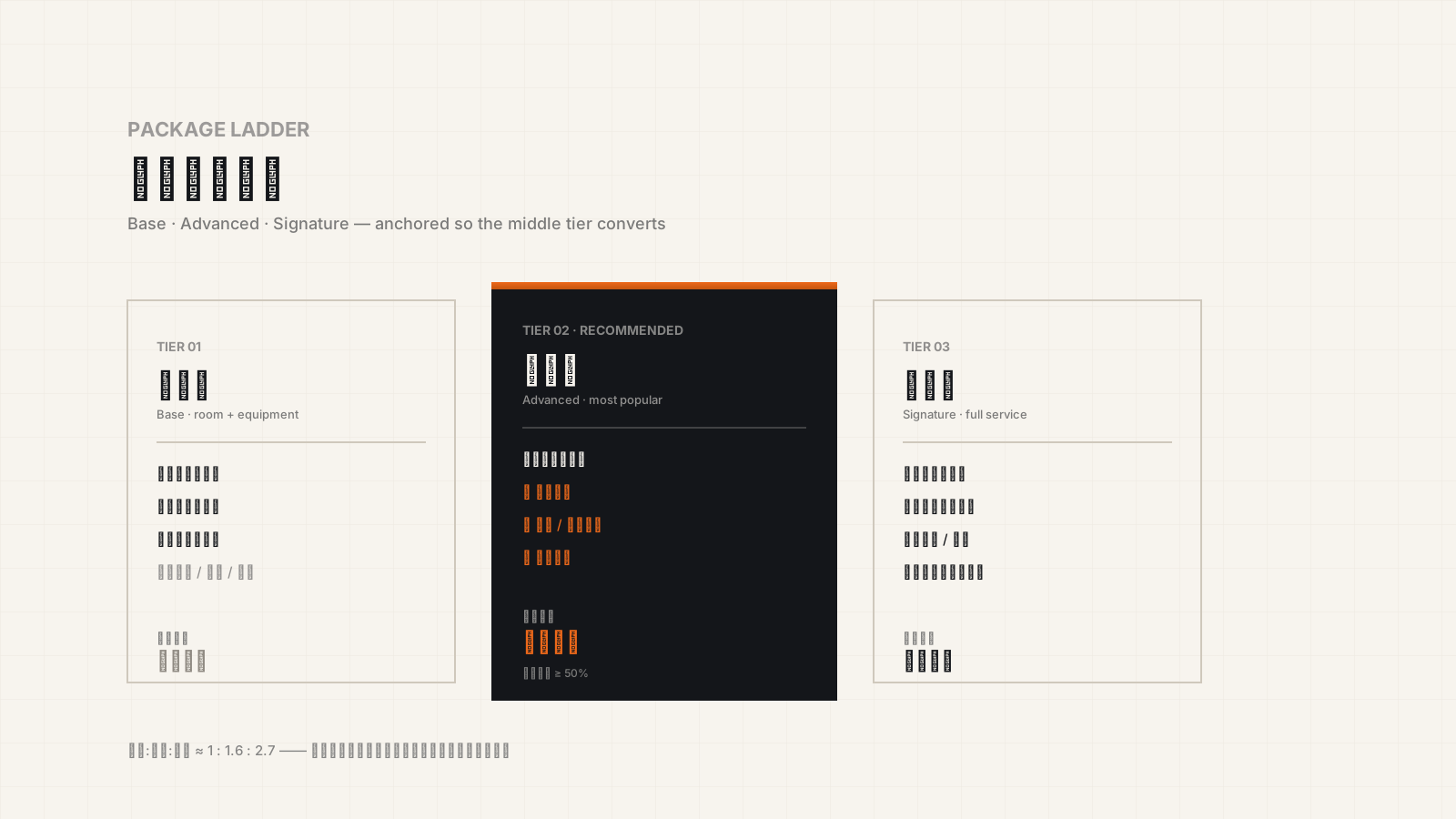
Do not build five or six tiers for group-event room packages — **three tiers is the golden structure**: Basic, Advanced, Premium. The design logic of three tiers is not simply "more content in sequence," but leveraging the **price anchoring effect** — most customers pick the middle tier, so the middle tier should carry the highest margin; the basic tier exists to "make the middle tier look like a bargain," and the premium tier to "raise the perceived value of the middle tier." Concretely: the Basic package includes only venue and equipment (just above break-even, thin margin), the Advanced package adds decoration, catering, and supervision on top of Basic (the thickest margin), and the Premium package adds photography, a dedicated host, and custom themes on top of Advanced (high margin but few choose it — its main role is anchoring).
The **price-gap ratio** between the three tiers also matters: the gap from Basic to Advanced should be small (so customers feel "a little more money gets a lot more"), and the gap from Advanced to Premium should be large (so most customers stop at Advanced). For example, Basic 980, Advanced 1580, Premium 2680 — Basic to Advanced adds 600 for decoration, catering, and supervision; Advanced to Premium adds 1100 for photography, hosting, and customization. Customers quickly calculate that Advanced is the best deal. This ratio is not a hunch; it exploits the "compromise effect" — people tend to choose the middle of three options.
The **visual presentation** of package content determines conversion. Do not just list text on a quotation sheet — build a three-tier comparison table: each tier lists "included items, suitable headcount, duration, what the customer gets," using checkboxes so customers see the differences at a glance. The Advanced row should be highlighted so the customer's eye naturally lands on the middle. Many venues cannot sell packages not because of price, but because customers finish reading without knowing how the three tiers differ or which one they should pick.
- Three-tier golden structure: Basic (break-even anchor), Advanced (profit mainstay), Premium (raises the anchor)
- Price-gap ratio: Basic-to-Advanced gap small (looks like a bargain), Advanced-to-Premium gap large (stops customers at the middle tier)
- Visual three-tier comparison table, highlight Advanced, let customers see differences at a glance and stop at the middle
Per-Session or Per-Head: Choosing the Pricing Model for Different Customer Groups
Team-building and buyouts suit **per-session pricing** — the customer buys "this time slot, this space is mine," and headcount floating within an agreed cap does not affect the price. This model is transparent to the customer and controllable for the venue, because the time value of the space is fixed. The key to per-session pricing is setting a "headcount cap": for example, the Advanced package caps at 30 people, with an extra charge per person above that. The cap must be set scientifically based on venue area and equipment capacity, not as high as possible — set it too high and the space gets crowded, experience drops, and reputation suffers; set it too low and customers feel it is not worth it.
Birthday parties suit **per-head pricing plus a package** — parents calculate "how much per child." The benefit of per-head pricing is that parents can easily compare horizontally ("another venue is 150 per child, yours is 180 but includes catering"), and the benefit of the package is bundling low-marginal-cost items like decoration, catering, and supervision to raise the average spend. Children and accompanying adults must be priced separately to avoid disputes when "a whole extended family shows up" — many venues have lost money here, with parents bringing seven or eight adults and only paying for the children.
The two pricing models can be **combined**: team-building Basic package is per-session, with extra headcount charged per head; birthday parties have a base per-head fee plus package upgrades. The core principle is "make it feel simple for the customer" — a quotation sheet should not have more than three pricing dimensions; too many dimensions confuse the customer, and confusion kills the signing. Keep the complex cost calculations inside the venue; what the customer always sees is one clear number plus a clear "what is included."
- Team-building buyouts are per-session: one price within the agreed headcount cap, extra charged per head
- Birthday parties are per-head plus package: parents compare by child count, the package lifts average spend, adults and children priced separately
- Combinable but never more than three pricing dimensions for the customer — simple and clear signs fast
Bundling Add-On Services: How to Charge for Catering, Decoration, Photography, Supervision
Add-on services are the **thickest-margin part** of group-event rooms, because their marginal cost is low and their perceived value is high. Add-on services fall into four categories: **catering** (drinks, light meals, cake service), **decoration** (balloons, backdrop boards, themed decor), **media** (photos, short videos, live streaming), and **labor** (host, supervisor, referee). Each category has a different pricing logic: catering is priced by cost markup (purchase price times 2 to 3), decoration by material cost plus labor, media by "number of deliverables" not "shooting duration" (the customer buys photos, not time), and labor by "one person, one hour."
The **bundling method** of add-on services matters more than individual pricing. Do not let customers choose from scratch — use "standard + optional": the Advanced package includes basic decoration and a round of drinks as standard, and customers can add photography, themed decoration, or a dedicated host. Standard items make customers feel "a lot is already included," and optional items let the venue make more money. Psychologically, once a customer has decided to buy a main product, their price sensitivity to add-ons drops sharply — which is why phone cases and screen insurance sell so well.
The **display order** of add-on services also matters: put the highest-margin items first, and the items customers are most likely to add in the most visible position. For example, for birthday-party add-ons, "first-birthday follow-shot" has a high margin and parents will probably buy it, so put it first; "add 30 balloons" has a low margin, so put it later. Do not sort by cost from low to high; sort by "customer purchase intent × margin" from high to low.
- Four add-on categories: catering (cost markup), decoration (materials + labor), media (by deliverable count), labor (by hours)
- Standard + optional model: Advanced package includes basic items, customers add high-margin items, exploiting post-purchase price-sensitivity drop
- Display order sorted by "purchase intent × margin," not by cost
Time-Slot Tiered Pricing: Price-Gap Design for Peak, Sub-peak, and Discount Slots
The time-slot value of group-event rooms varies enormously: **weekend afternoons** are peak slots (fought over by team-building and birthday parties), **weekday daytime** are discount slots (large empty blocks), and **evenings and Sundays** are sub-peak slots. The core of tiered pricing is "using price gaps to regulate demand" — peak slots are at full price and prioritized for high-value customers, discount slots use low prices to attract price-sensitive corporate team-building and school events, and sub-peak slots sit in between. The goal is not to sell out every slot, but to sell each slot at the price it deserves.
Recommended price-gap ratio: peak slots at 100% of the base price, sub-peak at 70–80%, discount at 40–60%. This ratio is not fixed; it depends on the venue's vacancy rate — if weekends are fully booked and weekdays are empty, widen the discount-slot gap to attract weekday traffic; if weekends also have gaps, narrow the gap to pull demand toward weekends. Use the time-slot report of the venue intelligent management system (¥58,000) to see the historical booking rate of each slot — data determines the gap, not gut feeling.
Tiered pricing requires **price transparency** — mark "weekend peak / weekday discount" prices directly on the booking page, do not wait for the customer to ask. Transparent pricing actually boosts conversion: price-sensitive customers will actively choose weekday discount slots, time-sensitive customers will choose peak slots, and both feel they got a good deal. The worst practice is "private-message for a quote" — customers smell a hidden catch and lose trust.
- Three slot tiers: peak (weekend afternoon) full price, sub-peak (evening/Sunday) 70–80%, discount (weekday daytime) 40–60%
- Price-gap ratio adjusted dynamically from historical vacancy data, not by gut feeling
- Transparent prices marked on the booking page, let customers self-select tiers, both sides feel they got a deal
Deposit, Balance Payment, and Rescheduling Rules: Eliminate Disputes in the Contract
The purpose of a deposit is to **lock the time slot**, not to make money. The recommended deposit amount is 20–30% of the total package price — too low and the customer's default cost is not enough, making no-shows likely; too high and customers dare not pay. The deposit should be collected when the booking is confirmed, and the balance settled before or upon arrival. The key is to write the nodes clearly: "deposit received locks the slot, balance settled by 18:00 the day before the event" — do not use vague phrasing like "settled before the event."
Rescheduling and cancellation rules should be **tiered**, with less refund the closer to the event date: more than two weeks in advance, one free reschedule (or 80% deposit refund); one week in advance, a 30% rescheduling fee; within three days, no reschedule or refund. This tiering is not an overbearing clause — it is reasonable, because the closer to the event, the harder it is for the venue to sell the empty slot, and the greater the loss. The rules must be clearly communicated before the deposit is paid, written into the confirmation sheet, and take effect only after the customer signs — do not spring them afterwards.
**Overtime and extra-person fees** must also be written down in advance: overtime charged in half-hour increments (not by the minute, too granular), extra people charged per head (pre-reported at the agreed rate, last-minute additions at full price). These "boundary fees" are the most common source of disputes; writing them in the most visible position on the quotation sheet costs ten times less than arguing afterwards. The contract template should list all six items — deposit, balance, rescheduling, overtime, extra people, damage compensation — and apply the template to every booking, no improvisation on the spot.
- Deposit 20–30% to lock the slot; write specific times for the balance node, not vague phrasing
- Tiered rescheduling/cancellation: two weeks free, one week 30% fee, within three days no refund — communicate and sign in advance
- Overtime in half-hour increments, extra people split into reported rate and last-minute rate — six boundary fees in the contract template
Corporate Client Quotation Strategy: Framework Agreements, Tiered Discounts, Payment Terms
The quotation logic for corporate clients is completely different from B2C — B2C customers look at "is it cheap," while enterprises look at "is it worth going through the process." Corporate quotations must be **structured**: the quotation sheet is divided into "base fees, add-on services, optional items," each clearly priced, with a total at the end. A corporate admin should be able to take this sheet and report directly to leadership without calling back to ask "does this include that." The clearer the quotation, the faster the enterprise decision.
For corporate clients with repeat potential, proactively propose a **framework agreement**: N events per year, enjoying a fixed discount and priority slots. The discount in a framework agreement should not be too large (80–90% off is enough); the focus is "priority slots" and "fixed process" — enterprises hate renegotiating terms for every booking, and a framework agreement saves them communication costs. Tiered discounts also apply: 3 events a year at 10% off, 5 at 15% off, 10+ at 20% off — trade repeat volume for price.
**Payment terms** are a special need of corporate clients. Government, state-owned enterprises, and large private companies usually have 30–90 day payment terms, which a small venue's cash flow may not withstand. The approach: for payment-term clients, require a 50% down payment (received before the event) with the balance on terms; or add 5–10% to the price for long-payment-term clients to cover the cost of capital. Do not take on payment terms beyond your cash-flow capacity just to win the booking — the enterprise will eventually pay, but the venue may not survive until then.
- Corporate quotations structured: base + add-on + optional, each clearly priced, so admins can report directly
- Framework agreement: N events/year at 10–20% off + priority slots, trade repeat volume and certainty for discount
- Payment-term handling: 50% down + balance on terms, or add 5–10% for long terms to cover capital cost
Birthday-Party & Family Pricing Psychology: Parents Pay for Peace of Mind, Not Cheapness
The decision psychology of birthday-party parents is completely different from corporate team-building. Parents are not comparing "which venue is cheaper" — they are comparing "which lets me worry the least." So birthday-party pricing should **emphasize "all-inclusive"** — decoration, equipment, catering, cake service, supervision, and photography all included, and parents only need to bring the child. The all-inclusive price looks more expensive than "venue fee + individual add-ons," but parents are calculating "I don't have to worry about anything," and this psychological value far exceeds a few hundred yuan in price difference.
Birthday-party **price tiers** should be divided by age group, not by items: ages 3–6 low-age package (soft-play focused, high supervisor ratio), ages 7–12 elementary package (competition focused, with tournament-style flow), and mixed-age package (older kids leading younger kids in collaboration). Each age group has a different cost structure (low-age needs more supervision, elementary needs more equipment), so pricing differs too. Do not use one "birthday party package" for all age groups — low-age parents feel there is not enough equipment, elementary parents feel it is too childish.
Birthday parties have one special pricing lever: **photography**. What parents want most is "photos and videos of my child having fun today," and the price sensitivity of this need is extremely low. Make "first-birthday follow-shot + 30 retouched photos + 15-second short video" a high-margin add-on (margin can reach 70%+), placed first in the add-on list. Many parents originally planned to shoot themselves, but see "only 200-something for a professional follow-shot" and add it — the profit from this one item may exceed the venue itself.
- Birthday-party pricing emphasizes "all-inclusive peace of mind" — parents pay a premium for not worrying, not for cheapness
- Tier pricing by age group: low-age (soft-play + high supervision), elementary (competition + tournament), mixed-age (collaboration)
- Photography is a high-margin add-on lever (70%+ margin), placed first in the add-on list
Price Anchoring & Competitive Positioning: How to Charge More Than Nearby Venues and Still Sell
Pricing does not forbid being more expensive than nearby venues — but **being expensive must have a reason**. When a customer sees you are 20% more than the venue next door, they will ask "why?" — and you need to answer that question in advance on the quotation sheet and display page. The reason for being expensive must be perceptible to the customer: for example, "our group room has independent air conditioning and sound insulation (the neighbor doesn't)," "we include professional follow-shot photography (the neighbor charges extra)," "we have tournament-style flow and a ranking screen (the neighbor only gives you the space)." List these differentiators next to the price, and the customer is no longer comparing "200 vs 240" but comparing "a 200 venue vs a 240 venue with decoration, photography, and flow included."
**Anchoring with a high-priced product** is another technique. Put a "Premium Custom Package" (very high price, very comprehensive content) in the package list — most customers will not choose it, but its existence makes the "Advanced package" look like a bargain. For example, Premium at 2980, Advanced at 1580 — the customer feels "Advanced is only half of Premium yet includes most of the content, what a deal." Without the Premium anchor, Advanced at 1580 might look expensive.
Competitive positioning should **avoid price wars**. If nearby venues are waging a price war, do not follow — cutting prices is easy, raising them is hard, and cutting loses both profit and brand. The correct approach is differentiation: others do "cheap buyout," you do "hassle-free all-inclusive"; others do "hourly rental," you do "per-event bundling." Shift the price anchor from "how much per hour" to "how much per whole event," and the customer's comparison object changes. Price wars are fought by venues without differentiation; differentiated venues fight value wars.
- Being expensive needs a reason: list differentiators (independent AC, included photography, tournament flow) next to the price, so customers compare value not price
- Anchor with a high-priced Premium package to make Advanced look like a bargain, exploiting the compromise effect
- Avoid price wars, differentiate: others compete on cheapness, you compete on hassle-free; others charge hourly, you charge per event
Pricing Review & Iteration: Adjust Prices with Data, Not Gut Feeling
Pricing is not set once and forgotten — it should be **reviewed monthly**. The review looks at four data points: **slot utilization** (peak below 70% means pricing is too high or acquisition is insufficient), **package conversion rate** (Advanced share below 50% means the three-tier design has a problem), **per-session gross margin** (below 50% means add-ons are not selling or costs are out of control), and **add-on rate** (below 30% means add-on display is inadequate). These four numbers tell you which part of pricing has a problem.
Price adjustments should be **small steps, fast iterations**, not one big jump. For example, if peak utilization is too high (over 90%), prices can be raised; raise 5–10% each time and observe for two weeks, do not raise 30% at once and scare customers away. If package conversion is low, adjust the content and price gaps of the three tiers instead of cutting prices directly. Use the pricing analysis report of the venue intelligent management system (¥58,000), which automatically compares "booking volume and profit changes before and after the price adjustment" to tell you whether this adjustment made or lost money.
The ultimate goal of pricing iteration is to **find the upper limit of willingness to pay for each customer group**. For birthday-party parents, test the conversion rate of "add photography"; for corporate team-building, test the signing rate of "framework agreement discount"; for buyout customers, test the acceptance of "overtime tiers." Every test is a pricing optimization; once enough data accumulates, you know how much each type of customer is willing to pay and why. At this stage, pricing is no longer gut feeling — it is precision guidance.
- Monthly review of four data points: slot utilization, package conversion rate, per-session gross margin, add-on rate
- Small-step price adjustments: 5–10% each time, observe two weeks, use system reports to see profit changes before and after
- Ultimate goal: find the willingness-to-pay ceiling of each customer group, from gut feeling to precision guidance
FAQ
Should group-event room pricing reference nearby venues?
You can reference but cannot copy. Nearby venue quotes tell you the market price range, but your cost structure, venue conditions, and service content all differ — pricing must be based on your own real costs and value proposition. The correct way to reference: know what nearby venues charge, then support your price with differentiation reasons — if you are more expensive, explain clearly what the extra money buys; if you are cheaper, confirm you will not lose money. Copying nearby prices without knowing your own costs will most likely lose money.
What is a reasonable price gap for the three-tier packages?
The gap from Basic to Advanced should be small (so customers feel a little more money gets a lot more), and the gap from Advanced to Premium should be large (so most customers stop at Advanced). A common ratio is Basic:Advanced:Premium = 1:1.6:2.7, for example 980/1580/2680. But the final ratio depends on your cost structure — Advanced must be the thickest-margin tier; if Advanced costs are too high and margins are thin, adjust the content or ratio.
How much deposit is appropriate?
20–30% of the total package price. Below 20% the customer's default cost is not enough and no-shows are likely; above 30% customers dare not pay. The deposit's purpose is to lock the slot and screen sincere customers, not to make money. For existing clients or framework-agreement clients the deposit ratio can be lowered; for new clients charge the standard. The slot is locked only when the deposit is received — verbal bookings do not count.
Should birthday parties be priced per head or per buyout?
Birthday parties suit "base per-head fee + package." The base per-head fee is charged by the number of children (for example 120 per child), and the package bundles decoration, catering, and supervision. Accompanying adults are priced separately (for example 30 per adult). This way parents can easily compare (how much per child), and the venue can lift the average spend through the package and adult fees. Do not quote birthday parties as "how much for a two-hour buyout" — parents will find it expensive.
What margin should add-on services target?
It differs by category: catering priced at 2–3 times cost (10 yuan purchase sells for 25–30), decoration at material cost plus 50–100% labor, media priced by number of deliverables (margin can reach 60–70% because marginal cost is nearly zero), labor at 1.5–2 times hourly rate. The overall target for combined add-on service margin is above 50%, making it the main profit source for group-event rooms.
What if a corporate client demands long payment terms?
Do not refuse directly, but set conditions. Approach one: 50% down payment (received before the event), balance on terms. Approach two: add 5–10% to the price for terms over 60 days to cover capital cost. Approach three: framework-agreement clients can get terms, ad-hoc corporate clients cannot. The core is not letting payment terms crush cash flow — the enterprise will eventually pay, but the venue may not survive until then.
How do I tell if pricing is too high or too low?
Look at slot utilization: peak slots consistently below 60% means pricing is too high or acquisition is insufficient; consistently above 90% means prices can be raised. Look at inquiry conversion: many inquiries but few signings means price or display has a problem. Look at competitor reaction: if nearby venues all price close to you, you are in a market-accepted range. The most accurate judgment is the monthly review of four data points (slot utilization, package conversion, per-session gross margin, add-on rate) — let the data speak.
Can I raise prices anytime?
Yes, but in small steps and with advance notice. Keep each increase to 5–10%, announce one week in advance on the booking page and in existing-client groups. Clients who have already paid a deposit keep the original price; give existing clients a "loyalty price-protection window" (for example, still at the original price within one month). When raising prices, also upgrade content (for example, add an add-on service) so customers feel "more expensive but also worth it." Do not raise prices quietly — customers will feel cheated when they find out.
What if the three-tier packages will not sell?
First check three causes: one, a display problem — customers cannot see how the three tiers differ, so rebuild the comparison table and highlight Advanced; two, an anchoring problem — the Premium price is not high enough to make Advanced look like a bargain, so raise Premium; three, a content problem — the Basic package has too much content, making customers feel no need to buy Advanced, so trim Basic. Packages that will not sell are usually not a price problem but a structure and display problem.
RELATED



CONTACT
Send Us Your Customer Mix
Tell us your venue's main customer groups (team-building / birthday party / buyout share), venue area, and local competition. We can provide reference suggestions for three-tier package structure, price-gap ratios, and time-slot tiered pricing. Once pricing is set, the next step is customer acquisition — see the Group-Event & Party Room Customer Acquisition and Productized Operations Guide for details.
2026-11-11