
VENUE OPERATIONS & REPEAT VISITS
Digital Sports Venue Operations & Repeat-Visit Playbook
How to run a digital sports venue after opening day: the metrics to watch during the opening ramp, time-slot allocation across three customer segments, a four-tier membership and stored-value structure, dynamic pricing that fills the troughs, tournament programming, weekday trough products, frontline staffing and secondary-spend design, plus a working annual operating calendar and four repeat-visit acceptance metrics.
Buying the right equipment and throwing a busy opening night is only the first hurdle for a digital sports venue. What actually determines whether the investment comes back is the repeat business and revenue per square meter in every month that follows — and those are precisely where most new venues are weakest. Opening month rides a wave of novelty, the second month halves, and by the third month the venue is surviving on discounts.
This guide is not about equipment selection. It is about how to run the venue once the doors are open. It works through eight areas — the opening ramp, segment structure, the membership system, pricing, tournament content, trough filling, frontline staffing and secondary spend — and closes with a practical annual operating calendar and four acceptance metrics for repeat business.

The opening ramp: what to watch in the first 90 days
The operating goal for the first three months is not profit. It is getting three curves to work: footfall, spend per visitor, and return frequency. Footfall is the one most easily misread — opening-period traffic is inflated by novelty and promotions, so those numbers cannot be used to justify later marketing spend.
Record four figures every week: entries, paid conversion (entries that become ticket sales), spend per head, and new memberships opened. For the first two weeks, check whether conversion is holding in a sensible range. From the third week, start watching return visits — whether the same customers come back within 14 days. The 14-day return rate is the only ramp-up metric that reliably predicts how the venue will trade later.
Do one calibration at the end of month one. If entries are high but conversion is low, the problem sits at the entrance experience and ticket pricing. If conversion is high but the return rate is low, the problem sits in content and member benefits. If both are low, do not spend more on marketing yet — go back to circulation and the equipment mix and find the cause there.
- Weekly: entries, paid conversion, spend per head, memberships opened
- From week three, watch the 14-day return rate closely
- Month-one calibration: low conversion means entrance and ticket price; low return means content and benefits
Three customer segments and how to split the clock
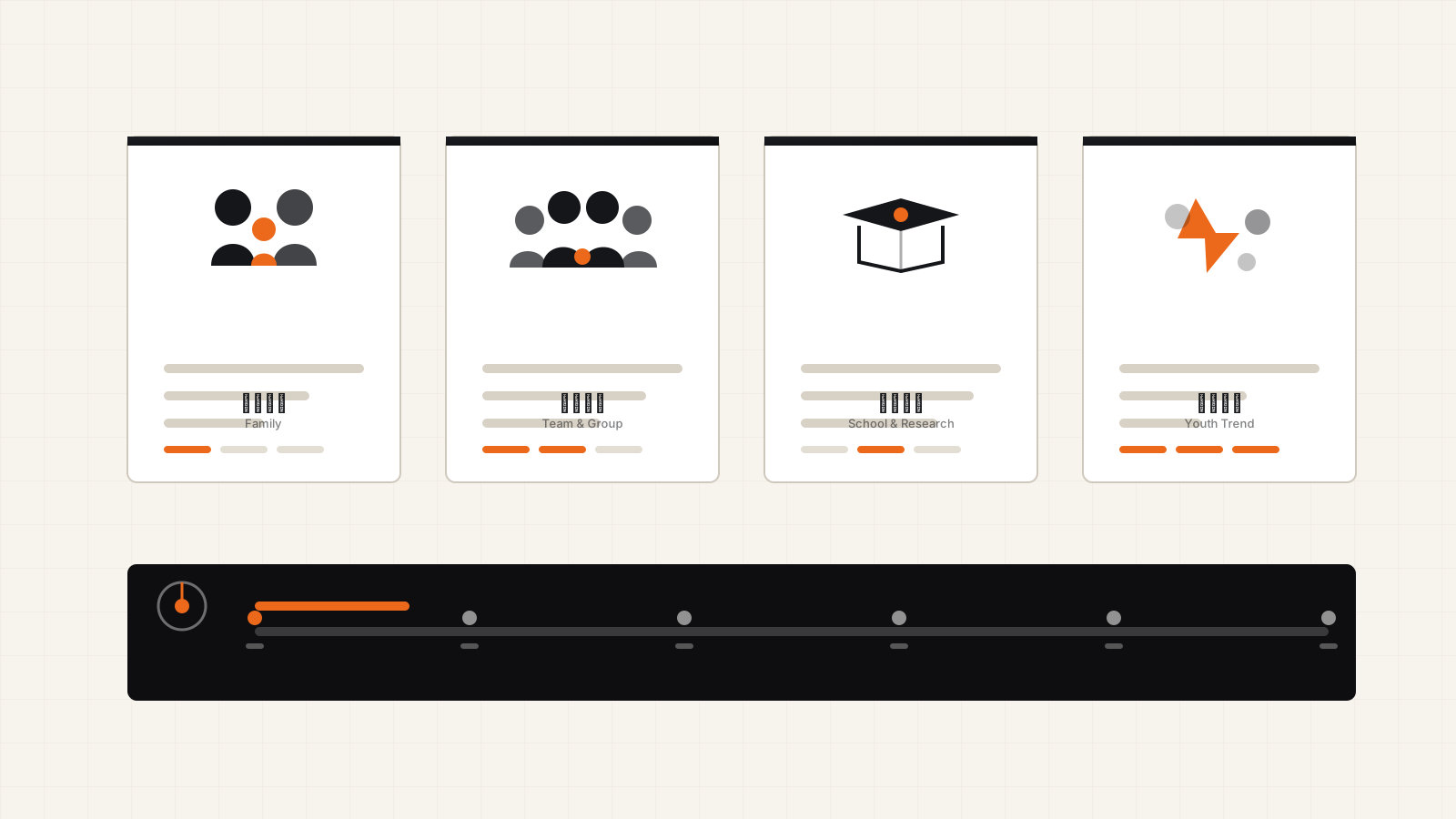
Traffic at a digital sports venue usually comes from three groups: families, mostly weekend daytime; young adults, mostly weekday evenings and weekend nights; and groups — corporate team building, school and institutional events — mostly on weekdays. Their equipment preferences, spending habits and dwell times are completely different, yet they share the same floor.
The core operating move is to stagger those three groups across time slots so the same equipment serves different people at different hours. On weekend days, cluster battle-format and child-friendly units along a family route. On weekday evenings, push competitive and leaderboard-driven units at young adults. Weekday daytime goes to groups, reusing the floor through exclusive bookings and programmed sessions.
Time-slot allocation has to show up in staffing and equipment strategy, not just on a spreadsheet. Which units are promoted, how many staff are on the floor, the music and the lighting should all shift by daypart. Plenty of venues have good equipment and still underperform, because they run the same playbook from open to close — and every segment ends up feeling the place was not built for them.
- Families: weekend daytime, battle and child-friendly units
- Young adults: weekday evenings and weekend nights, competitive and leaderboard units
- Groups: weekday daytime, exclusive bookings and programmed sessions
Membership and stored value: turning one visit into a relationship
Stored value is not about getting customers to pay in advance. It is about giving them a reason to keep coming back. Before designing a membership program, answer three questions: why would someone sign up, what do they get every time they visit after signing up, and how long before you reach out if they stop showing up? Those three questions map onto sign-up benefits, in-venue benefits, and a win-back mechanism.
A four-tier structure works well: free registration to capture contact details and preferences, a visit pass to lower the barrier to a second purchase, a stored-value card to lock in longer-term spending, and an annual tier that bundles a set visit frequency with exclusive time slots. There should be a clear upgrade path between the tiers so frequent customers move up naturally, rather than piling every benefit onto the top tier from day one.
On the data side, you need to be able to answer four questions: what share of revenue comes from members, how much stored value is outstanding, what the 30-day return rate is, and how much of the benefits issued are actually redeemed. A very high stored-value balance is not healthy — it means future revenue has already been consumed and you are carrying refund exposure. A low redemption rate means the benefits were designed without reference to what customers actually want.
- Four tiers: free registration → visit pass → stored-value card → annual membership
- Four numbers: member revenue share, stored-value balance, 30-day return rate, benefit redemption rate
- Low redemption rate means benefits are disconnected from demand
Pricing: use price to fill the troughs
The goal of pricing at a sports venue is not to charge more. It is to make sure every time slot has people in it. Floor costs accrue by the hour whether or not anyone is on it, so an empty slot is a straight loss. That makes the first principle of pricing very simple: open up the spread between peak and off-peak rather than setting one flat price and discounting it later.
Three tools cover most of it. Time-band tickets give you peak, standard and off-peak rates, with off-peak clearly below peak. Bundles package the sports zone with food and beverage, retail, or existing arcade machines. Group tickets use a per-head tiering to reward people for arriving together. Each tool solves a different problem: redistributing demand, lifting spend per head, and widening the customer base.
Once pricing is live, watch two things. Is peak still running at capacity? If so, there is room to charge more. Are the troughs actually filling? If not, either the price gap is too small or nobody knows about it. Change one price band at a time and keep a comparison, so you can tell which adjustment did the work instead of reshuffling everything at once and learning nothing.
- Peak, standard and off-peak time-band tickets
- Bundles lift spend per head; group tickets widen the customer base
- Change one price band at a time and keep a control
Tournaments and events: turning equipment into content
Sports equipment has a natural advantage: it is inherently competitive and watchable, which means it can produce content on its own — weekly leaderboards, monthly tournaments, inter-venue challenges, parent-and-child contests. The point of tournaments is not the revenue on the day. It is giving customers a reason to come back next time, and generating material worth sharing.
A rhythm that works: a weekly leaderboard, which costs nothing and keeps the room active; a monthly themed tournament with prizes, which pulls in the middle of the customer base; a quarterly inter-venue competition with nearby venues, which extends reach; and an annual championship that consolidates the core community. Four levels of frequency cover the whole path from everyday engagement to a real community.
Three things matter in execution. Rules should be simple enough to explain in one sentence. Prizes should relate to the sports experience rather than being straight cash. And every event should leave you with photo and video material. That footage is the best advertisement for the next event, and it is the one content asset a social feed can keep producing.
- Weekly leaderboard → monthly themed tournament → quarterly inter-venue event → annual championship
- Rules explainable in one sentence; prizes tied to the experience
- Every event must leave you with usable photo and video
Filling the troughs: putting weekday daytime to work
Late morning to mid-afternoon on weekdays is dead time at almost every indoor sports venue. The fixed costs for those hours have already been incurred, so any revenue you add is essentially margin. That makes it worth designing a dedicated product rather than simply cutting the price.
Three directions are worth testing: light-activity classes for parent-and-child and older-adult slots, exclusive bookings for corporate and school team building, and cross-promotional packages with nearby businesses. What they share is that they are booked by session, have a controllable headcount, and put little wear on the equipment — which matches exactly what a trough slot can offer.
The key to trough operations is not price. It is certainty. Group buyers need to know the space, the duration, the running order and your capacity to host them. Standardize the hosting process, publish the slots that can be booked, and put your rates into a tiered table. Conversion will be noticeably better than negotiating case by case on the day.
- Light-activity classes: parent-and-child and older-adult slots
- Group bookings: corporate and school team building
- Cross-promotions: packages with nearby businesses
Staffing and floor management: putting people in the right place
An operating plan ultimately depends on the people who execute it. Staffing at a sports venue usually splits into three roles: ticketing and guest services (entrance greeting, membership sign-up, answering questions), floor hosting (explaining rules, running matches, safety patrols), and maintenance (equipment checks, fault response, replacing consumables). The three demand very different skills, so managing them against one set of performance measures usually means none of them is done well.
The first principle of scheduling is to follow the traffic, not the timesheet. Weekend days and weekday evenings are the staffing peaks, weekday mornings need the leanest possible crew, and trough hours can redirect people to equipment servicing, floor cleaning and content capture so that empty time still produces value. The split between part-time and full-time depends on how steep your peaks are: the steeper the peak, the more flexibility part-time hours buy you.
Move the measures from "how much did we sell" to "did the sessions run smoothly": sessions hosted in the same slot, customer wait time, equipment fault response time, and tournament participation. Judge guest services on experience metrics, floor hosts on sessions delivered and participation, and maintenance on fault rate and response time. Only when they are measured separately does the floor actually improve.
- Three separate roles: guest services, floor hosting, maintenance
- Schedule to traffic; move trough hours into servicing and content
- Measure how smoothly sessions run and how fast you respond, not revenue alone
Secondary spend: food and beverage, retail and value-added services
Ticket revenue sets the ceiling on footfall; secondary spend sets the value of each customer. At a sports venue it usually comes from four directions: drinks and light food, retail accessories (socks, protective gear, small sports items), paid extras (photos and video, claw and gift machines, lockers and rentals), and group or class services. Their margin structures differ widely, so they should not be pushed with equal effort.
The key to designing secondary spend is that it should sit on the way, not require a detour. Put drinks and the rest area mid-route so parents who are waiting have an obvious place to buy; put retail and prize redemption on the exit route so customers make one small decision on their way out; tie digital products such as photos and video to the ticketing account so they can still be bought after leaving. Location drives conversion; price is only the second factor.
A higher secondary-spend share is not automatically better. When food and retail take too large a share, it usually means tickets are underpriced or the floor is being squeezed by non-sports uses. When secondary spend is close to zero, the circulation and dwell-time design is the problem. The sensible approach is to review the mix each quarter and aim growth at items related to the sports experience, rather than bringing in merchandise that has nothing to do with the concept.
- Four categories: food and drink, retail, paid extras, group and class services
- Put them on the way: drinks by the rest area, retail and redemption at the exit
- Watch the mix rather than the total; grow sports-related lines
Churn warning signs and member win-back
The other half of repeat-business management is managing churn. Customers will not tell you they have stopped coming, but the data will: the date of their last visit, benefits left unredeemed, a stored-value balance that never moves, and no more tournament entries. Turn those four signals into a churn-warning sheet, tier it by risk level, and you can intervene before the customer is gone for good.
Win-back actions have to be tiered; one coupon for everyone will not work. For customers just past 30 days, remind them with new content or a new tournament. Past 60 days, bring them back with a benefit for a limited time slot. Past 90 days, call them or talk one-to-one in the community and ask what actually happened — was it price, content, distance or the service experience? The first two tiers aim to get the visit back; the third aims to get information you can act on.
Judge win-back on three numbers: reach rate, return rate, and secondary spend after the return. If you only send coupons and never ask why, win-back turns into a permanent discount and eventually damages your price structure. Classifying and recording the reason behind every win-back is the real input for iterating operations.
- Four churn signals: last visit, unredeemed benefits, frozen balance, no tournament entries
- Tier win-back at 30 / 60 / 90 days, with a different action at each
- Track reach rate, return rate and post-return spend; record the reason
On-site service and complaint handling
Complaints at a sports venue cluster into four types: queues and booking clashes, equipment failing without warning, minor safety knocks, and benefits that are not clearly explained. These come up almost every day, and how they are handled decides whether the customer comes back — research suggests that customers whose complaint was handled well often show a higher intent to return than customers who never complained at all.
Build a standard handling card: separate first (take the customer away from the floor so other guests are not affected), then confirm (restate the issue and confirm whether they want a refund, compensation or an explanation), then offer a solution (fix on the spot what can be fixed on the spot, and give a clear deadline for what cannot), and finally log it (record it in the shift log and categorize it). Frontline staff need a defined authority limit, with anything above it escalated; otherwise every case waits for a supervisor and the customer waits too long.
Complaint data should be summarized weekly and reviewed by type for trends. If one category rises for three weeks running, the problem is not staff attitude — it is the process or the equipment itself. That is the point to change the process, not to retrain the script.
- Four frequent complaints: queues, faults, knocks, benefit explanations
- Four steps: separate → confirm → resolve → log
- Give frontline staff a clear authority limit and avoid layer-by-layer escalation
The annual operating calendar and repeat-visit acceptance
Putting a year of operating activity into a calendar is what turns operations from firefighting into a rhythm. Four levels work: the year sets the themes and the flagship tournament, the quarter sets membership benefit iterations, the month sets tournaments and promotions, and the week sets staffing and content updates.
Judge repeat business on four metrics: the 30-day return rate (do members come back within 30 days of buying?), member revenue share (what proportion of total revenue comes from members?), annual spend per customer (the cumulative spend of one customer over a year), and benefit redemption rate (how much of what you issued was actually used). These four say far more about the quality of the business than a single month of takings.
One point worth stressing: operations is an ongoing investment, not a one-time act at opening. Equipment content refreshes by season, tournaments run on a monthly schedule, benefits iterate quarterly, and data gets reviewed weekly. Hold that rhythm for a year and it will do more for the venue’s long-term results than any single promotion.
- Four-level calendar: year, quarter, month, week
- Four acceptance metrics: 30-day return rate, member revenue share, annual spend per customer, benefit redemption rate
- Keep investing: seasonal content, monthly tournaments, quarterly benefits, weekly reviews
FAQ
Should a new venue run promotions in its first month?
Yes, but the goal should be acquiring the first batch of customers who will come back, not chasing revenue. Use a low-barrier trial ticket paired with member registration so opening traffic converts into trackable member data, rather than a crowd you never see again.
What usually causes a low repeat-visit rate?
Three common causes: content that does not change (people get bored after one visit), member benefits that do not match demand (people sign up and feel no value), and no reason to return (no tournaments, no events, no slot-specific privileges). Start the diagnosis with benefit redemption rate, then look at the 30-day return rate.
Is a higher stored-value balance always better?
No. A very high balance means future revenue has already been spent and you are carrying refund and service-capacity risk. The healthier approach is to tie stored value to benefits so the balance gets consumed through actual usage patterns, rather than pursuing stored-value volume for its own sake.
Do tournaments and events require a big budget?
No. A weekly leaderboard is close to free if it uses the ranking features the equipment already has. A monthly tournament needs little more than prizes and simple rules. The real investment is in inter-venue and annual events, and those are best run once your community has some scale.
How should weekday trough slots be priced?
The fixed costs for those hours have already been incurred, so pricing only needs to cover variable cost and bring in incremental traffic — which means it can sit well below peak rates. What matters alongside price is a standardized hosting process and publicly bookable slots. Group buyers value certainty more than the lowest quote.
How often should operating data be reviewed?
Weekly for traffic and conversion, monthly for repeat business and member structure, quarterly for how well benefit iterations are working. Weekly reviews guide staffing and messaging; monthly and quarterly reviews guide content refresh and benefits design.
How do you win members back without it feeling like harassment?
Tier by how long they have been away, and give different people different reasons. Within 30 days, remind them about new content and new tournaments. Around 60 days, offer a benefit for a limited time slot. Past 90 days, talk to them one-to-one and find out why. Avoid blasting the same coupon to the whole list, or win-back degrades into routine discounting.
What share of revenue should secondary spend account for?
There is no universal number; it depends on the floor layout, whether food and beverage are included, and who your customers are. A more reliable test is the trend and the mix: is the growth coming from sports-related items, is it squeezing out sports floor space, and are tickets being over-subsidized? If the mix has deteriorated two quarters running, it is time to adjust.
We are short-staffed on the floor — should we hire part-time or full-time first?
Look at how steep your peaks are first. Venues with a sharp weekend and evening peak and a very quiet weekday daytime are better off adding part-time hours. Venues with fairly even traffic all day, and which need stable hosting and maintenance capability, should prioritize core full-time roles. Either way, hosting and maintenance should not rely entirely on temporary staff.
RELATED
- Indoor digital sports venue investment and opening guide
- Digital sports equipment procurement and selection guide
- Shopping mall digital sports park planning guide
- Arcade and FEC digital transformation guide
- Digital sports venue customer acquisition and local marketing playbook
- Digital sports venue equipment safety and maintenance guide
- Digital sports venue space design and circulation planning guide
CONTACT
Send us your operating data
Share your floor area, equipment mix, opening date and current membership data, and we will outline a suggested framework for segment time slots, membership structure and trough-filling programs.
2026-11-09