
ARCADE / FEC TRANSFORMATION GUIDE
Arcade & FEC Digital Transformation Guide
A practical transformation playbook for traditional arcades and family entertainment centers (FEC): from asset audits, equipment replacement sequencing and legacy machine disposal, to space and circulation redesign, ticketing and membership restructuring, compliant cashless payment, tournament community building and a 90-day transformation rhythm — a phased path you can actually execute.
Traditional arcades and family entertainment centers (FEC) are facing the same set of pressures: an aging customer base, homogenized prize and redemption machines, and revenue growth that has plateaued because it depends almost entirely on token sales. At the same time, digital sports social venues built around interactive sports, head-to-head competition and shareable moments are competing for the same families and young adults — with higher revenue per square meter and longer dwell times.
Transformation does not mean ripping out every old machine. A mature arcade transformation path is phased: first audit your venue and membership assets, then validate footfall and spend per visit with a small sports-themed pilot zone, and only then decide on a full renovation. This guide follows the decision sequence of real projects, helping operators complete an FEC upgrade without putting core cash flow at risk.
Why traditional arcades need to transform
The pressure on arcades usually comes from three directions. First, audience aging: core players have migrated to mobile and console gaming, while families cannot find content they can experience together. Second, equipment homogenization: machines in neighboring venues are nearly identical, leaving price wars and prize costs as the only levers. Third, tightening regulation: machines with coin-payout or prize-redemption features face clearer compliance requirements in many markets.
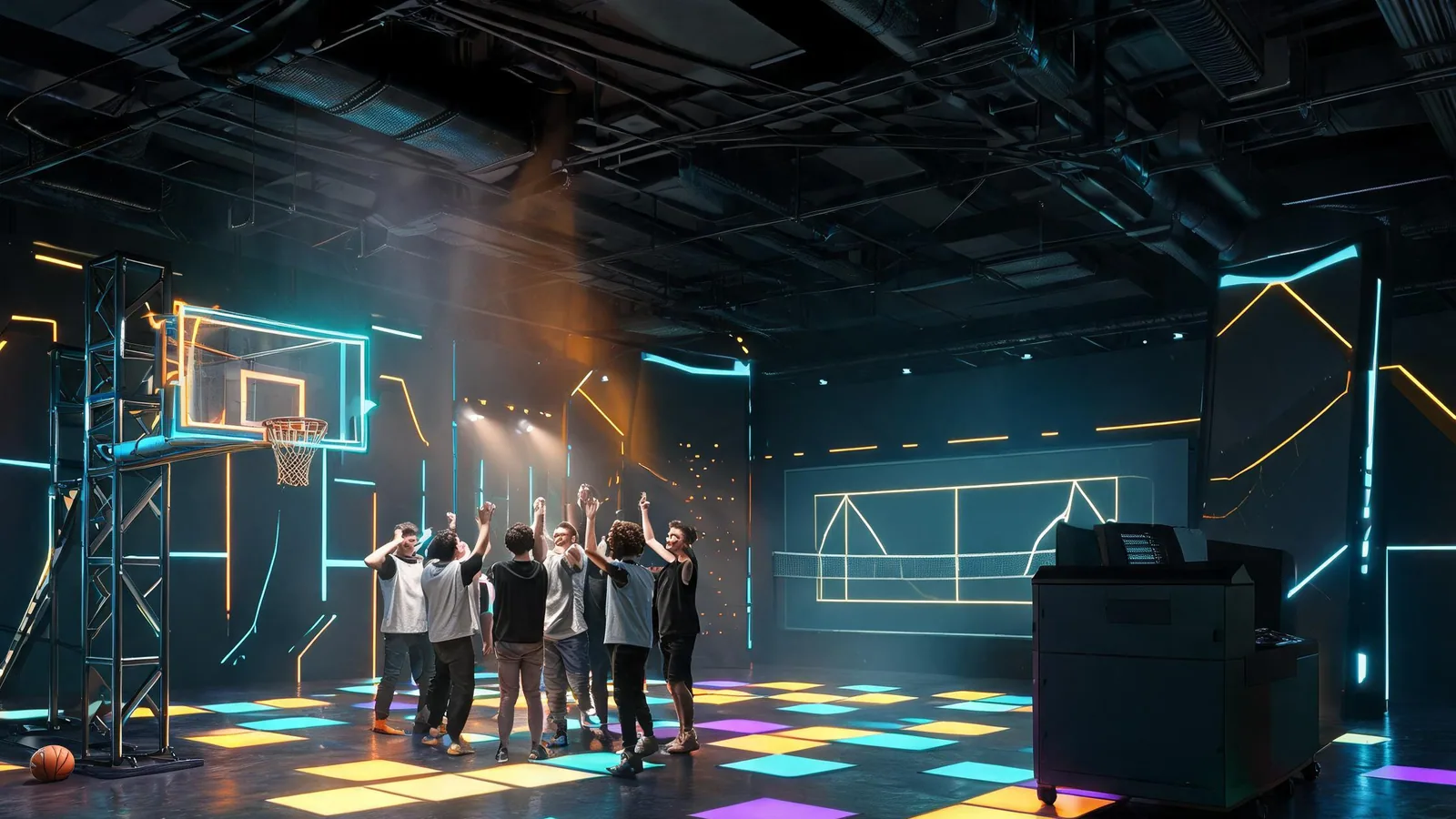
The digital sports social venue offers a different content structure. Physical participation is the core, so the equipment is naturally competitive, cooperative and watchable; sessions are short and turnover is fast; and content can be refreshed by season. For families it is “a sport we can play together”; for young adults it is “a match worth filming and sharing”. These are exactly the two groups traditional arcades have been losing.
Be clear about one thing: arcade transformation is not replacing the business model — it is restructuring the content mix. Prize machines and claw machines still deliver stable cash flow. The goal of transformation is to enlarge the traffic pool with a sports-themed zone, then let the existing machines share in that new traffic.
- Aging audience: steady loss of young and family customers
- Homogenized equipment: competing only on price and prize cost
- Single revenue stream: over-reliance on token sales
- Compliance pressure: tighter rules on coin-payout and redemption machines
Audit your assets first: venue, members and revenue structure
The first step of an FEC upgrade is not choosing equipment — it is auditing three categories of assets. Venue assets include usable clear height, column grid, floor load capacity, power capacity and fire-safety conditions. Sports equipment is far more demanding on these than ordinary machines, and every item must be re-verified at the planning stage.
Membership assets are the most underestimated part of an arcade: stored-value balances, visit frequency, visit time slots and the share of family customers directly determine how the post-transformation ticketing structure should be designed. Export at least a year of member spending data and segment it into four tiers — high-frequency/high-spend, high-frequency/low-spend, low-frequency/high-spend and low-frequency/low-spend — to identify the core customers most worth retaining.
For revenue structure, keep three ledgers: machine revenue broken down by category (prize, redemption, video, kiddie), revenue per square meter broken down by zone, and gross margin per unit after deducting prize and maintenance costs. This ledger becomes the basis for deciding which zones to renovate first and which machines to keep.
- Venue: clear height, column grid, floor load, power, fire safety
- Members: balances, frequency, time slots, family share
- Revenue: machine takings, zone productivity, per-unit gross margin
Equipment replacement order: validate first, then scale
Successful arcade transformations are almost never done in one sweep. The recommended three-step sequence starts with carving out 10%–20% of floor area as a sports-themed pilot zone. Choose interactive equipment with short sessions and strong spectator appeal — interactive projection, motion-sensing battles or competitive challenge units — and validate entry conversion and spend per visit over one to two months.
In step two, adjust the mix based on pilot data: traffic-driver machines bring people in, anchor machines carry dwell time, and battle-and-leaderboard machines drive social sharing. During the pilot, record per-unit usage frequency, queuing behavior and knock-on secondary spending — not just per-machine revenue.
Step three is the scale-up: replicate the validated mix across a larger area while optimizing the legacy fleet on the principle of “keep high-margin machines, retire low-efficiency ones”. Across the three steps, transformation spend is spread over multiple operating cycles, and cash-flow risk is far lower than a one-shot overhaul.
- Step 1: pilot a sports zone on 10%–20% of floor area
- Step 2: tune the mix across traffic, anchor and battle layers
- Step 3: scale the validated mix and optimize the legacy fleet
Legacy machines: keep, refresh or retire
Transformations tend to swing to one of two extremes: tearing everything out and clearing machines that still generate cash flow, or refusing to touch anything, so the sports zone gets squeezed into a corner where it builds no atmosphere and pulls no traffic. The right approach is to give every machine a keep-or-go verdict.
Three criteria drive that verdict: per-unit gross margin, usage frequency and floor-space efficiency. Machines with healthy margin and stable frequency stay, and should be placed along the mandatory path of the new circulation so the traffic the sports zone generates passes them naturally. Machines with acceptable margin but dated looks can be refreshed — new cabinet shells, lighting and game interfaces extend their useful life. Low-margin, high-failure, space-hungry machines should be phased out, and the floor area they free up goes to validated sports equipment.
Legacy machines also play an easily overlooked role: they are the familiar entry point for families. Parents recognize prize and claw machines; children are drawn to the novelty of sports equipment. Put the two on the same route and a family is more likely to stay together than in a pure sports venue.
- Three criteria: per-unit gross margin, usage frequency, floor-space efficiency
- High-margin machines moved to the mandatory path of the new circulation
- Dated machines refreshed with new shells, lighting and interfaces
- Low-efficiency machines retired, floor area handed to validated equipment
Space and circulation: make spectators your second machine
The spatial logic of a sports zone differs from a traditional machine floor. Traditional machines are “one player, one machine”; sports equipment is “one plays, many watch” — the crowd is both atmosphere and the next wave of players. Circulation design must deliberately preserve spectator positions, keeping waiting and viewing areas adjacent to the equipment rather than pushing units into corners.
Hardware conditions need item-by-item verification: clear height affects projection, lighting and large interactive installations; the column grid determines whether equipment can be grouped; power capacity must be recalculated against the peak draw of sports equipment; and for running-and-jumping units, floor cushioning and protective enclosures must be completed during fit-out, not retrofitted later.
Cashier and ticketing touchpoints should move with the circulation. Once cashless, customers no longer queue to buy tokens, so entrance gates or self-service kiosks should be positioned to serve “fast entry”, releasing the saved floor area for roving staff and secondary-spend touchpoints.
See application scenarios and space casesTicketing and membership: from selling tokens to selling time
Traditional arcade revenue is denominated in tokens — customers pay per play. A digital sports social venue is denominated in time and privileges — customers pay per experience. During the transition the two structures usually coexist: keep token tickets serving legacy machines while introducing timed tickets, session passes and bundles for the sports zone.
A three-layer ticketing structure works well: single tickets acquire new visitors by lowering the first-experience barrier; bundles package the sports zone with legacy machines to lift whole-store spending; membership and stored value lock in repeat visits, reinforced by points, leaderboards and seasonal rewards. The stored-value system should carry over existing member accounts so long-time customers’ balances are never split or stranded.
Base pricing on your own pilot data, not on competitors’ price lists. Record full-capacity hours and price acceptance by time slot during the pilot, then work back to per-hour capacity. Weekend peak pricing and weekday off-peak pricing can be spread apart, using price to pull traffic into the troughs.
- Single tickets acquire, bundles lift spend, membership retains
- Timed tickets for the sports zone coexist with token tickets
- Differentiate peak and off-peak pricing to fill weekday troughs
Compliance and payment: doing cashless the right way
Compliance is the bottom line of any arcade transformation. Regulatory treatment of coin-payout and prize-redemption machines varies by jurisdiction, so the transformation plan should proactively move toward a “points redeemed for prizes” model: game outcomes convert to points, points are exchanged in-store for prizes or privileges, and no cash is ever paid out.
Cashless payment is the companion move: RFID wristbands, QR-code accounts or mini-program balances replace physical tokens, cutting cash-handling costs while making every transaction traceable. On the data side, maintain three audit ledgers — spending records, points flow and prize redemption — to meet transparency requirements.
Minor protection must be written into operating rules: time-slot restrictions, spending alerts and accompaniment requirements should be stated at the point of sale, and content should be age-rated per machine. Compliance spending is not a cost item — it is the license foundation of long-term operation.
- Points-for-prizes model replaces coin payout and redemption
- Cashless payment via wristband / QR code / mini-program
- Three audit ledgers: spending, points, redemption
- Age-based time slots and content ratings for minors
Tournaments and community: turn one-time players into regulars
The biggest advantage of sports equipment is comparability — there are scores, leaderboards and opponents. That makes it a natural fit for tournaments, and tournaments are the cheapest tool for converting a one-time visit into repeat visits. Novelty carries the opening month; three months later, the schedule carries footfall.
Events do not have to be heavy productions. Day to day, run weekly leaderboards and challenge missions so players can compete for a ranking whenever they like. At weekends, host fixed-time head-to-head matches with live announcing and big-screen leaderboards to build atmosphere. Monthly or quarterly, run themed events across stores or regions to pull in players from nearby communities. The key is a stable rhythm: customers knowing that “there is a match every Saturday night” builds habit far better than an occasional large event.
Community is an extension of tournament play. Bring competitors, members and families into a group where you publish schedules, rankings, event sign-ups and member-day reminders. The point is not to broadcast ads but to keep supplying reasons to visit and a sense of participation — a screenshot of a leaderboard or a clip of a match often drives repeat visits better than a discount.
- Daily: weekly leaderboards, challenge missions, open ranking
- Weekend: fixed-time matches with live announcing
- Monthly: themed events and cross-store tie-ins to build community
- Community: schedules, rankings, sign-ups and member-day reminders
Team and roles: from watching machines to running the floor
The most common hidden resistance to an arcade transformation comes from the team. Staff in a traditional venue watch machines, swap tokens and hand out prizes; a sports zone needs people who explain rules, organize matches, build atmosphere and keep order. Same people, a completely different way of working.
During the transition, split floor roles into three: service staff handle card issuance, ticketing and wayfinding, with the priority of getting first-time visitors smoothly into the experience zone; floor hosts explain rules, form teams and MC events, and are the core of the atmosphere; maintenance staff handle equipment inspections, cleaning and simple fault-fixing, keeping machines running through peak hours. Small teams can combine roles, but responsibilities must be written down.
Training should follow the opening rhythm: equipment operation and safety training during fit-out, live drills and script polishing during soft opening, and continuous training against the event calendar after the formal opening. Incentives need to change too — put member repeat visits, event participation and customer ratings into appraisals rather than judging on daily takings alone.
- Service: card issuance, ticketing, entry guidance
- Floor host: rule briefings, team forming, event MC
- Maintenance: inspections, cleaning, simple fault-fixing
- Appraisals include repeat visits, event participation and customer ratings
A 90-day transformation rhythm and acceptance metrics
Split the transformation into three 30-day blocks. The first 30 days cover the asset audit, design and fit-out — the priority is getting the pilot zone’s physical conditions right in one pass. The second 30 days are a soft opening whose core job is data collection: entry conversion, per-unit usage frequency, spend per visit and repeat rate, recorded item by item. The third 30 days adjust the mix and pricing against the data, then open formally.
Acceptance metrics should focus on four items: revenue per square meter (compared zone by zone, before and after), traffic structure (shift in the family and young-adult share), repeat rate (the share of members returning within 30 days), and secondary-spend share (food, beverage and retail attach). These four expose problems far earlier than top-line revenue alone.
Transformation is not a one-off project — it is a switch in how the venue operates. Equipment content refreshes by season, events run on a monthly calendar, and member privileges iterate quarterly. These actions belong in the venue’s annual operating calendar, not switched off after opening day.
- Days 1–30: audit, design, construction
- Days 31–60: soft opening and data collection
- Days 61–90: tune the mix, set pricing, formal opening
- Long term: seasonal updates, monthly events, quarterly privilege refreshes
Failure signals: five signs to stop the bleeding now
Problems in a transformation project usually surface two to three months after opening. The earlier they are identified, the cheaper the correction. If two or more of the five signals below appear at the same time, pause expansion and go back to the data.
First, traffic in the pilot zone is not spilling over to legacy machines — the circulation or the mix is wrong, and new traffic is being wasted. Second, usage stays concentrated on a handful of units while the rest sit idle — the mix is out of balance. Third, membership sign-ups are strong but repeat visits are weak — the experience has novelty but no reason to come back. Fourth, weekdays are almost empty — group and booking business has not been built. Fifth, staff are still serving the sports zone with a token-selling mindset — training and appraisal have not caught up.
Stopping the bleeding is not the same as starting over. In most cases, adjusting the circulation and equipment placement, reworking the ticketing mix, and adding an event calendar plus group sales will bring the project back on track. The real danger is the habit of “adding more equipment without changing operations” — spending keeps climbing while the underlying problem never gets solved.
- New traffic never spills over to legacy machines
- Usage heavily concentrated on a few units, or idle for long stretches
- Strong membership growth but a low repeat rate
- Weekday traffic and group business missing
- The team is still stuck in a token-selling mindset
FAQ
Does an arcade transformation require replacing all old equipment?
No. The recommended path is to pilot a sports-themed zone on 10%–20% of floor area, validate traffic and spend per visit with one to two months of data, then decide how far to expand. High-margin legacy machines can stay and share the new traffic with the new zone.
What special venue requirements does sports equipment have?
Focus on four items: usable clear height (affects projection and large installations), floor load capacity (a baseline requirement for running-and-jumping equipment), power capacity (recalculated against peak draw), and floor cushioning plus protective enclosures (anything touching sports safety must be completed during fit-out). A measured site survey at the planning stage is strongly advised.
What happens to existing member stored value during the transformation?
Carry over the original account system — never wipe or split balances. Timed tickets and session passes for the sports zone merge into the same member account, so long-time customers can use their stored value across both old and new formats, while new privileges guide them into the new zone.
Will cashless payment exclude older customers and children?
Cashless does not mean service-less. Wristband tapping and QR accounts are actually friendlier for children and accompanying parents, and a staffed service point remains on site to help with card issuance and top-ups. In practice, cashless mainly replaces the token-buying queue — entry efficiency improves.
Where are the main compliance risks in an arcade transformation?
They concentrate in three areas: the regulatory treatment of coin-payout and redemption machines, transparent audit ledgers for points-based gameplay, and minor-protection rules. The plan should proactively shift to a points-for-prizes model, keep three traceable ledgers (spending, points, redemption), and write age-based time slots and content ratings into the ticketing rules.
How do we judge whether the transformation is working?
Watch four metrics rather than single-day revenue: zone-level revenue per square meter, shifts in the family and young-adult share, 30-day member repeat rate, and the secondary-spend share from food, beverage and retail. Expanding only after pilot data meets target is a far more reliable standard than opening-day crowds.
How should the transformation budget be allocated?
Follow a “validate first, expand later” split: concentrate the first phase on equipment, flooring and power upgrades in the pilot zone, and hold back a portion for opening marketing and working capital; commit to expansion only once pilot data hits target. The exact ratio depends on venue conditions and the state of existing equipment — avoid copying one benchmark figure.
Should old machines be sold or kept?
Start with per-unit gross margin, usage frequency and floor-space efficiency. High-margin machines with stable frequency stay and move onto the new circulation; machines that look dated but still have an audience can be refreshed with new shells and interfaces; low-margin, high-failure, space-hungry units phase out gradually. The disposal route should also account for local second-hand equipment prices and the remaining lease term.
What if the team cannot keep up with the transformation?
Separate the floor roles clearly — service, floor host and maintenance, each trained on its own track, with live drills during the soft opening. Move appraisals from “daily takings” to a combined score covering repeat visits, event participation and customer ratings, and pair it with continuous training against the event calendar. The shift in working style usually takes two to three months.
RELATED
- Indoor Digital Sports Venue Investment and Opening Guide
- Digital Sports Equipment Procurement and Selection Guide
- Shopping Mall Digital Sports Park Planning and Operations Guide
- Digital Sports Venue Operations and Repeat-Visit Playbook
- Digital Sports Venue Customer Acquisition and Local Marketing Playbook
- Digital Sports Venue Equipment Safety and Maintenance Guide
- Contact us
CONTACT
Send us your venue and equipment list
Share your floor area, clear height, current equipment categories and membership scale — we will propose a phased transformation sequence, a pilot-zone mix and a ticketing framework.
2026-11-09