
Hotel & Resort Solutions
Digital Sports Zone Planning & Operations Guide for Hotels and Resorts
How hotels and resorts should configure a digital sports zone: starting from the business logic of length of stay and on-property spending, covering the family and conference guest mix, converting fitness centers and idle spaces, light-renovation low-noise all-ages equipment selection, area and investment tiering, bundling with room packages and guest privileges, off-season fill strategies, reusing existing hotel staff, safety and maintenance under a high share of children, common failure modes, and a phased rollout cadence.
The most common mistake hotels and resorts make with entertainment facilities is treating them as an afterthought amenity — a gym with a few treadmills, a kids corner to keep children busy, and the job is considered done. The result is a facility that sits empty year-round, adding nothing to room rates or on-property spending. The problem is not the equipment but the positioning: for a hotel, an entertainment facility is not a cost line — it is an operating tool that extends length of stay, lifts spend per guest, and fills the off-season.
This guide starts from the hotel's business logic and works through the guest mix, where the space comes from, equipment selection, area and investment tiers, bundling with room packages and privileges, off-season fill, staff reuse, and safety and maintenance — closing with the common failure modes and a phased rollout. One judgment runs through it all: can a digital sports zone become the reason a guest comes back, and stays one more night?
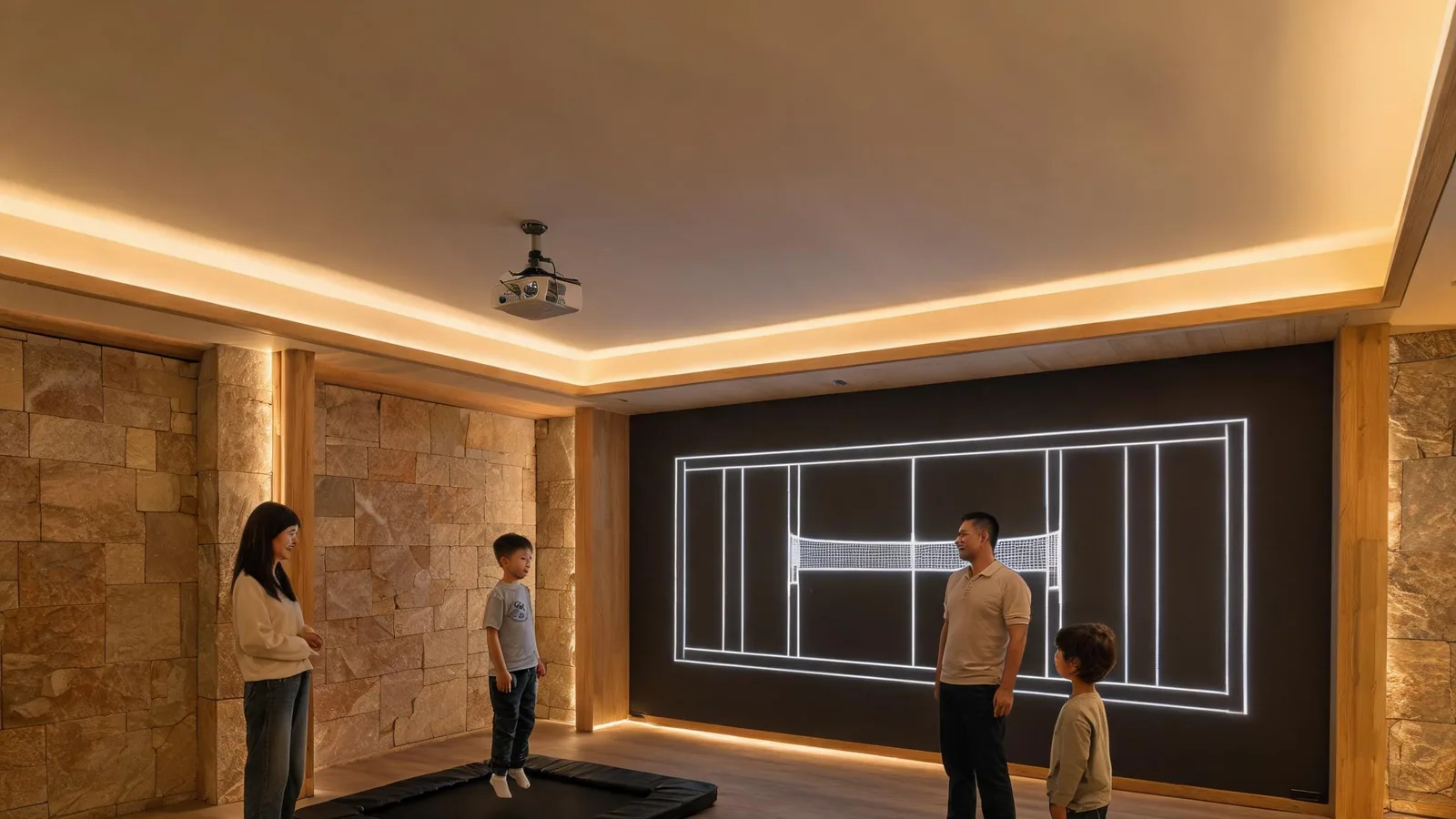
Start with Why: What a Digital Sports Zone Does for a Hotel
A hotel's revenue formula is simple: room rate × room nights, plus on-property secondary spending. A digital sports zone moves both variables at once. For families, "the kids have something to do" is a major reason for choosing a hotel — a sports zone that keeps children engaged for two hours straight often decides whether the parents book one night or two. For the hotel, every extra hour a guest stays on property is another chance for dining, retail, and entertainment revenue.
Unlike a standalone digital sports venue in a mall, a hotel sports zone does not need to attract its own traffic — the guests are already in the building. That means its job is not acquisition but **retention and conversion**: turning the two aimless hours after dinner, the boring rainy afternoon, and the gap before checkout into entertainment time guests are willing to pay for. Different positioning means different equipment selection, pricing, and operations.
There is one more often-overlooked value: **review content**. A family hotel's rating depends heavily on how children experience the stay, and a child's experience is most easily defined by play. A well-equipped, well-maintained sports zone shows up again and again in the photos and reviews guests post — marketing material no advertising budget can buy.
- Moves both variables: room nights + on-property secondary spending
- The goal is retention and conversion, not traffic acquisition
- The child's experience drives a family hotel's reviews and repeat bookings
Guest Mix: Families Are the Core, Meetings and Team Building Fill the Gaps
A hotel sports zone's guest mix is completely different from a standalone venue's. **The core is families with children**, peaking on weekends and school holidays. Kids play while parents supervise — the parent makes the purchase decision, but the child is the user, so equipment must satisfy both "fun for kids" and "reassuring for parents." **The second group is meeting and team-building guests**, the main weekday filler: they arrive in concentrated groups, at fixed times, on company budgets, and need equipment that supports group competition with rankings.
Two more groups should not be ignored. **Couples and younger guests** are highly receptive to socially shareable equipment — VR battles, competitive shooting, simulated sports — and they play mostly in the evening. **Seniors and supervising adults** do not play themselves, but they decide how long the kids can stay: comfortable seating, charging points, and a supervision area with clear sightlines directly shape how this group rates the facility.
Let the equipment mix follow the guest mix. A family-led resort should center on all-ages, low-barrier equipment parents and children can play together; a hotel combining conferences and leisure must keep competitive equipment that can host ten to twenty people in simultaneous groups; the small sports corner of a city business hotel works best with single-player, drop-in-and-go machines.
- Families are the core: children use it, parents decide — satisfy both
- Meetings and team building fill weekdays: group competition with rankings
- The supervision area shapes chaperone ratings: seating, charging, clear sightlines
Where the Space Comes From: Fitness Centers, Idle Rooms, and Lobby Corners
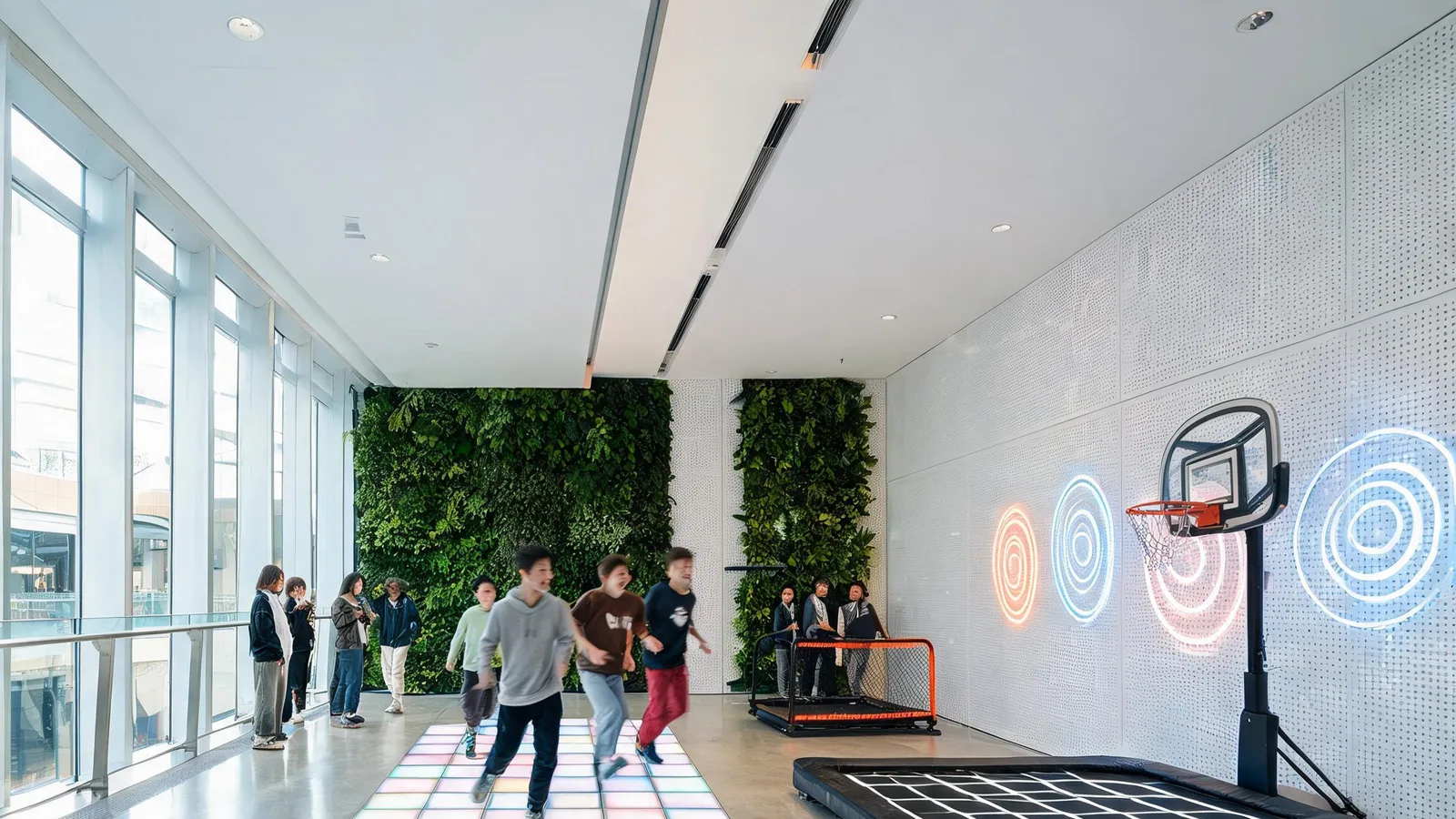
A hotel's biggest advantage is that **the space already exists**. The most common first choice is **converting the fitness and recreation center**: traditional facilities (gym, table tennis room, card room) see low usage and contribute little revenue, yet their ceiling height, load capacity, and circulation already meet requirements — making them the lowest-construction-cost path to a digital sports zone. The second source is **idle function space**: underused meeting rooms, banquet pre-function areas, and basement levels become ready-made sports zones once lighting and ventilation are solved.
The third source is **the edges of lobbies and corridors**. Hotel lobbies often contain large areas that are "visible but unusable," well suited to single-machine experiences — simulated shooting, interactive projection, self-service photo booths — that need no enclosed room and add energy to the lobby. Choose low-noise, clean-looking machines for these spots so they do not disturb the front desk or the lounge.
Evaluate every candidate space against four hard conditions: **ceiling height** (larger equipment demands more clear height — survey the space before fixing the equipment list), **load-bearing** (some machines are heavy; older buildings need floor-load verification), **sound insulation** (there must be a buffer between the sports zone and guest rooms — collisions and cheering must not carry to the floors), and **fire code** (if the conversion changes fire zoning, align with the hotel's engineering and fire departments first). Fail any one of the four, and change the plan for that space.
- Fitness-center conversion first: lowest construction cost, conditions already in place
- Lobby corners take single machines: low noise, clean look, no enclosed space needed
- Four hard conditions: height / load / sound insulation / fire code — fail one, change the plan
Equipment Selection: Light Renovation, Low Noise, All Ages
The hotel setting imposes three constraints a standalone venue never faces. **Light renovation**: equipment must arrive without major construction — the hotel is operating, and construction noise and dust directly hurt room reviews. Prefer machines that arrive whole and work the moment they are installed, minimizing on-site work. **Low noise**: sports zones often sit next to guest rooms and restaurants, so machine noise and player cheering must stay controllable. Sound effects can be turned down; the machine's own mechanical noise must be measured during selection.
**All ages**: hotel guests range from four to seventy, so the equipment mix must cover three layers — interactive projection and motion games for young children, competitive battles and VR for teenagers, simulated sports and shooting for adults. A kids-only zone shuts teenagers and adults out; a zone of nothing but high-intensity competitive equipment scares families away.
Within this framework the product matrix maps cleanly: interactive projection and motion-sensing titles suit young children and parent-child play; VR battles, simulated archery, and laser shooting cover teenagers and younger adults; simulated tennis and indoor cycling serve fitness-minded grown-ups. Self-service terminals (photo booths, ice cream machines) belong at the zone entrance or rest area as supporting units, turning waiting and departure moments into small transactions.
- Light renovation: machines arrive whole, plug-and-play, no hard construction
- Low noise: measure mechanical noise during selection — adjustable sound effects alone are not enough
- Three-layer all-ages coverage: motion play for kids / competition for teens / simulated sports for adults
How to Tier Area and Investment
There is no standard size for a hotel sports zone, but there is a clear tiering logic. **Small (tens to 200 square meters)**: a corner of the fitness center or lobby with three to six machines focused on single-player and motion experiences. The goal is simply "having one" — letting guests write "the hotel has a game zone" in reviews. Investment stays controlled and capital-recovery pressure is low. **Medium (200–600 square meters)**: a standalone zone with eight to fifteen machines covering all three age layers, able to charge by the hour or bundle into packages — it starts becoming one of the hotel's selling points.
**Large (600 square meters and above)**: the choice for resort and destination hotels — twenty-plus machines with clear zoning (young-kids area, competition area, rest area), able to sell tickets independently and host outside guests and team-building events. At this scale it is already an independent business unit inside the hotel and needs full venue-style operating planning.
Do not guess the investment — run it through a tool first: input your scenario, area, and city tier to get reference values for the equipment list, investment range, operating-cost share, and capital-recovery window. One principle bears repeating: **set the business goal before the area**. Decide whether the zone is an amenity, a selling point, or an independent business unit, and the area and budget answer themselves. Circle a piece of floor first and figure out what to do with it later, and you will almost always configure it wrong.
- Three tiers: small amenity / medium selling point / large independent business unit
- Run the investment range through the calculator first, then set the tier by business goal
- Goal first, area second — never in reverse
Integrating with Room Inventory: Vouchers, Packages, and Guest Privileges
The biggest difference between a hotel sports zone and a standalone venue is that it can integrate with the room-inventory system. **Bundle it into room types**: family rooms and suites carry play-all-day privileges, directly supporting a rate premium — what guests pay extra for a "breakfast for two + unlimited kids zone" package routinely exceeds what the zone would earn selling tickets on its own. **Distribute it as a privilege**: members receive a free-play voucher at check-in; two-night stays earn a family pass. The sports zone becomes part of the loyalty program at a cost far below room discounts.
**Time-based pricing**: in-house guests peak in the evenings and on rainy days; conference groups fill weekdays. A single price list cannot serve both flows. Layer the pricing — guest privilege rates, conference package rates, walk-in rack rates — so guests keep their sense of privilege while weekday capacity is not wasted. Every voucher and privilege must be redeemed through the system, never logged by hand at the front desk. Hand-logged privileges become untraceable within three months: no one can say how many were issued or used.
Bowlanding Ant's Venue Smart Management System (¥58,000) covers five modules: ticketing, membership, tournaments, loyalty points, and analytics. Once the zone is connected, room-voucher QR codes redeem directly, guest spending posts to member profiles, and usage and time-of-day data flow into the analytics module. This integration turns the sports zone from "a corner of the recreation department" into part of the hotel's revenue-management system — which room type should carry which privilege, and which time slot should push which package, all become data-backed decisions.
- Bundle into room types for rate premium; grant privileges for loyalty — cheaper than room discounts
- Layered time pricing: guest privilege / conference package / walk-in rates
- All vouchers and privileges redeemed in-system, feeding revenue management
Filling the Off-Season: The Sports Zone as a Counter-Cyclical Tool
A resort hotel's deepest pain is the off-season: empty weekdays, non-holiday traffic cut in half. The sports zone is a naturally counter-cyclical fill tool. **Meetings and team building** are the first lever: when companies choose meeting venues, "what can the team do after the sessions" increasingly drives the decision. A sports zone that can host a department offsite gives the hotel one more card in conference quoting, and team-building groups spend on weekday afternoons — exactly the in-house guest trough.
**Nearby residents**: local families on short weekend outings may not book a room but will come and spend. Open day passes and multi-visit cards to families within three kilometers, pair them with the family restaurant, and you have a complete day-trip product. This segment ignores occupancy — it is pure incremental revenue. **Tournaments and events**: monthly points leagues, parent-child challenges, and holiday-themed events give guests a reason to "come this month," turning random visits into planned ones.
The tournament system does not need to be complicated: small daily events keep activity up, monthly events build rankings, quarterly flagships create buzz. Registration and points run through the management system; prizes come from the hotel's own inventory — room vouchers, dining vouchers, afternoon tea. The cost is marginal; the publicity is full-value. This is how the sports zone's off-season role inverts: in season it supports the rooms; off-season it brings guests to them.
- Meetings and team building fill weekdays — the first off-season lever
- Day passes and multi-visit cards for nearby families: pure incremental revenue without room nights
- Three-tier tournaments with hotel-owned prizes: marginal cost, full-value buzz
Staffing by Reuse: Run It with the Team You Already Have
A small or mid-size zone needs no dedicated team — it runs on existing hotel staff. **Front desk and concierge** handle voucher sales and redemption training — QR-code redemption follows the same flow as restaurant vouchers. **Recreation-department staff** cover daily duty and basic guest guidance; one employee can staff a mid-size zone's normal shift. **Engineering** handles daily checks and minor faults, with complex issues going to the manufacturer's remote diagnostics and on-site support.
The precondition for shared roles is **standardized training and process**: each machine's safety instructions, the steps for common faults, and the daily opening and closing checklists are each written on a single page posted in the staff area. When new equipment arrives, the manufacturer's engineer delivers operation and safety training, and the hotel names one or two "equipment owners" as long-term points of contact.
One position cannot be cut: **on-floor supervision at peak hours**. During weekend and holiday family peaks, a dedicated person must walk the zone — guiding children's safety, managing queues, and handling equipment anomalies immediately. Scheduling follows the demand forecast: shared roles on weekdays, extra hands on weekends, full staffing on holidays — the same forecasting logic as room housekeeping.
- Front desk sells and redeems, recreation staffs the floor, engineering does daily checks — shared roles suffice
- One-page standardization: safety notes / fault handling / opening-closing checklists
- Peak-hour floor supervision is non-negotiable; schedule against the same forecast as rooms
Safety and Maintenance: Special Requirements When Children Dominate
Children make up a far larger share of a hotel zone's users than of a standalone venue's, so safety standards must follow the strictest version. **Equipment safety**: check corner guards, soft padding, and emergency stops item by item; nothing in the young-kids area may have pinch points or hard sharp edges. Safety instructions on every machine use icons plus bilingual labeling so parents grasp them at a glance. **Supervision design**: the young-kids area must sit within sight of the parent rest area — from a lounge chair, a parent should see their child's whole session. This is not only a safety requirement; it is also the experience requirement that makes parents willing to stay.
**Hygiene management**: everything children touch gets wiped daily. Motion-controller grips, VR headset liners, and soft-play structures each have their own cleaning frequency and consumable-replacement cycle. During flu season and hand-foot-and-mouth outbreaks, raise the disinfection frequency and post it at the entrance — parents care far more about hygiene than about how new the equipment looks.
**Maintenance cadence** binds to traffic: a power-on self-check before opening each day, a structural inspection weekly, a deep service monthly — all logged. A failed machine gets an "out of service" sign and a same-day repair ticket. A broken machine with no sign means children failing the same game over and over, and that frustration turns directly into a parent's one-star review. Maintenance data goes into the management system's service module and is managed alongside the equipment lifecycle.
- Strictest safety standard: guards, padding, emergency stops checked item by item; bilingual icon instructions
- The young-kids area must sit within parental sightlines — a safety and experience requirement at once
- Failures signed and reported the same day; maintenance logged in the system
Common Failure Modes: Why Many Hotel Sports Zones Never Take Off
Post-mortems of failed hotel sports zones converge on a handful of causes. **First, wrong positioning**: the zone is treated as a recreation amenity to satisfy an inspection, with no intent for it to earn revenue or support room rates — filler equipment in a remote corner, predictably idle all year. **Second, wrong selection**: copying a mall arcade's equipment list while ignoring the hotel's all-ages guest mix and noise constraints — kids find it babyish, adults find it loud, parents find it chaotic.
**Third, disconnection from room inventory**: the zone is accounted for and run independently — room vouchers do not redeem, packages cannot bundle — so guests find it awkward and the front desk cannot sell it, until it becomes a corner open to a handful of outside visitors. **Fourth, no ownership**: no responsible person, no daily checks, no repair deadlines. Machines break one by one; six months later only half of them work. Once a hotel sports zone slips into this "half-broken" state, it hurts the hotel's reputation more than having none at all.
**Fifth, going all-in at once**: opening at the highest spec, fully built out, means heavy investment and a slow capital-recovery path. The moment operating pressure rises, the operating budget gets cut, and the vicious cycle begins. The right responses to these five failure modes are covered in the chapters above: set the goal first, select by guest mix, integrate with room inventory, write it into process, invest in phases. The method is not complicated — what is hard is running it as a real product.
- Five failure modes: wrong positioning / wrong selection / disconnected from rooms / no ownership / all-in at once
- A "half-broken" zone hurts reputation more than having none
- The five counter-moves: set goals, select by guest mix, integrate rooms, write process, phase investment
Rollout Cadence: Prove One Zone Before You Scale
Roll out in three phases. **Phase one (months 1–3)**: take a corner of the fitness center or lobby, install three to six all-ages machines, and connect redemption and membership channels — the goal is to validate guest response: in-house usage rate, privilege redemption rate, and review mention rate. Run all three metrics for a full quarter, then let the data decide whether to expand. Keep phase-one spending small enough that "even if the judgment was wrong, the loss is affordable."
**Phase two (months 3–6)**: once the data clears the bar, expand to mid-size — complete the zoning and the rest and supervision areas, launch time-based pricing and conference packages, and start monthly tournaments. In this phase, finish connecting every module of the management system so the sports zone enters the hotel's revenue-management reports. **Phase three (month 6 onward)**: use quarterly data for equipment rotation and category adjustments; large resorts can now evaluate upgrading the zone into an independent business unit open to outside guests.
One last thing: fold the sports zone into the hotel's **annual asset review** — equipment stays or goes based on output data, privileges adjust based on redemption data, and next year's tournament calendar is set from participation data. The hotel industry's advantage is complete guest data and a clear repeat-purchase chain. Once the sports zone is wired into that system, it stops being a cost center of the recreation department and becomes a revenue line you can see in the reports.
- Phase one validates three metrics: usage / redemption / review mentions
- Phase two scales up with full system integration, entering revenue reports
- Phase three: routine rotation, folded into the annual asset review
FAQ
How much space does a hotel need for a digital sports zone?
There is no standard answer — tier it by business goal: tens to 200 square meters as an amenity (3–6 machines), 200–600 square meters as a selling point (8–15 machines with all-ages zoning), 600 square meters and above as an independent business unit. Decide first whether the goal is amenity, selling point, or standalone unit, and the area and investment answer themselves.
The hotel is operating — will equipment installation disturb guests?
With the right equipment selection, very little. Prefer machines that arrive whole and work the moment they are installed, avoiding major on-site construction; schedule necessary installation and commissioning during low-occupancy windows and physically separate work areas from guest circulation. This is exactly why "light renovation" matters in hotel settings — the equipment adapts to the hotel, not the other way around.
Should the sports zone be free for guests or chargeable?
Layer it: bundle basic play privileges into room types or membership benefits (supporting rate premium and loyalty), charge per session or per hour for high-value equipment and extended play (generating secondary spending), and quote conference and team-building groups as packages. Tune the free-to-paid ratio to your guest mix, and redeem every voucher and privilege through the system — never by hand at the front desk.
Do we need to hire a dedicated operations team?
Not below mid-size. Front desk and concierge double on voucher sales and redemption, recreation staff cover floor duty and guidance, engineering handles daily checks, and the manufacturer provides remote diagnostics and on-site support. The one position you cannot cut is peak-hour floor supervision — weekends and holidays must have a dedicated person walking the zone, scheduled against the same demand forecast as rooms.
Will equipment noise reach the guest rooms?
Control it at the selection stage: prefer low-noise machines — adjustable sound effects are only a supplement. When evaluating sites, confirm a buffer between the zone and guest-room floors (distance, partitions, or an intervening function space), and place high-decibel competitive equipment in its own sub-zone. Solve noise before the conversion; do not wait for guest complaints to patch it.
How do we make use of the zone in the off-season?
Three levers: meetings and team building (concentrated weekday-afternoon spending that strengthens your conference quotes), day passes and multi-visit cards for nearby families (pure incremental revenue without room nights), and monthly points leagues plus themed events (turning random visits into planned ones). Fund prizes from the hotel's own room and dining vouchers — marginal cost, full-value buzz.
How is children's safety ensured?
Apply the strictest standard: check corner guards and soft padding item by item, place the young-kids area within parental sightlines, and make safety instructions bilingual and icon-based. Contact surfaces like motion grips and VR headset liners have their own cleaning frequencies. Failed machines are signed and reported the same day. Maintenance records are logged in the management system's service module.
How does the zone integrate with the hotel's room-inventory system?
Through the Venue Smart Management System (five modules: ticketing, membership, tournaments, loyalty points, and analytics): room-voucher QR codes redeem directly, guest spending posts to member profiles, privileges and packages get layered pricing, and usage data flows into analytics. Once connected, the zone enters the hotel's revenue-management reports — which room type should carry which privilege becomes a data-backed decision.
How long before we know whether the zone is working?
One quarter. Watch three metrics: in-house usage rate (zone traffic divided by guests in house), privilege redemption rate (how many issued vouchers get used), and review mention rate (the share of new reviews mentioning the zone). Let all three run for a full quarter before deciding whether to expand or adjust — do not make decisions on the novelty bump of the first two weeks.
RELATED
 Digital Sports Park Implementation for Cultural Tourism
 Digital Sports Venue Operations & Repeat Purchase Playbook
 Space Design & Circulation Planning for Digital Sports Venues
 Indoor Digital Sports Venue Investment & Opening Guide
 Tournament Operations & Membership Points Guide
 Customer Acquisition & Local Marketing for Digital Sports Venues
 Equipment Safety & Maintenance Management Guide
CONTACT
Send Us Your Hotel Floor Plan
Tell us your hotel type, available space, and guest mix, and we can offer reference recommendations on zone tiering, equipment mix, and privilege bundling.
2026-11-11