
Sports Park Solutions
Digital Sports Venue Planning & Operations Guide for Sports Parks
How sports parks and urban sports centers should plan a digital sports venue: starting from the logic of balancing public welfare and commercial operation, covering the visitor mix of nearby families, teenagers, and team-building groups, using new amenity space and existing space such as under-stand areas, weather-resistant low-maintenance all-ages equipment selection, area and investment tiering, pricing design for free-or-reduced public hours versus operating hours, cross-promotion with park courts and trails, school partnerships and community tournaments, reusing park management staff, safety and maintenance under high usage intensity, and a phased rollout cadence.
Behind the sports park construction boom lies a common operating dilemma: outdoor courts, trails, and playgrounds are free or nearly free to use, maintenance costs rise year after year, and the park itself has no stable revenue stream. Venues sustained by fiscal funding age fast and fall behind on service; introducing commercial projects invites the accusation of "turning public welfare into business." A digital sports venue happens to untie this knot — it is a sports-and-entertainment facility the public genuinely enjoys, consistent with the public-welfare positioning of fitness for all, while generating operating income that feeds back into park maintenance.
This guide starts from the sports park's logic of "balancing public welfare and operation," then works through the visitor mix, where the space comes from, equipment selection, area and investment tiers, pricing models, cross-promotion with the park ecosystem, school partnerships and tournaments, staff reuse, and safety and maintenance — closing with a phased rollout cadence. One core judgment runs through it all: can a digital sports venue become both a "fitness benefit" for residents and a "revenue engine" for the park?
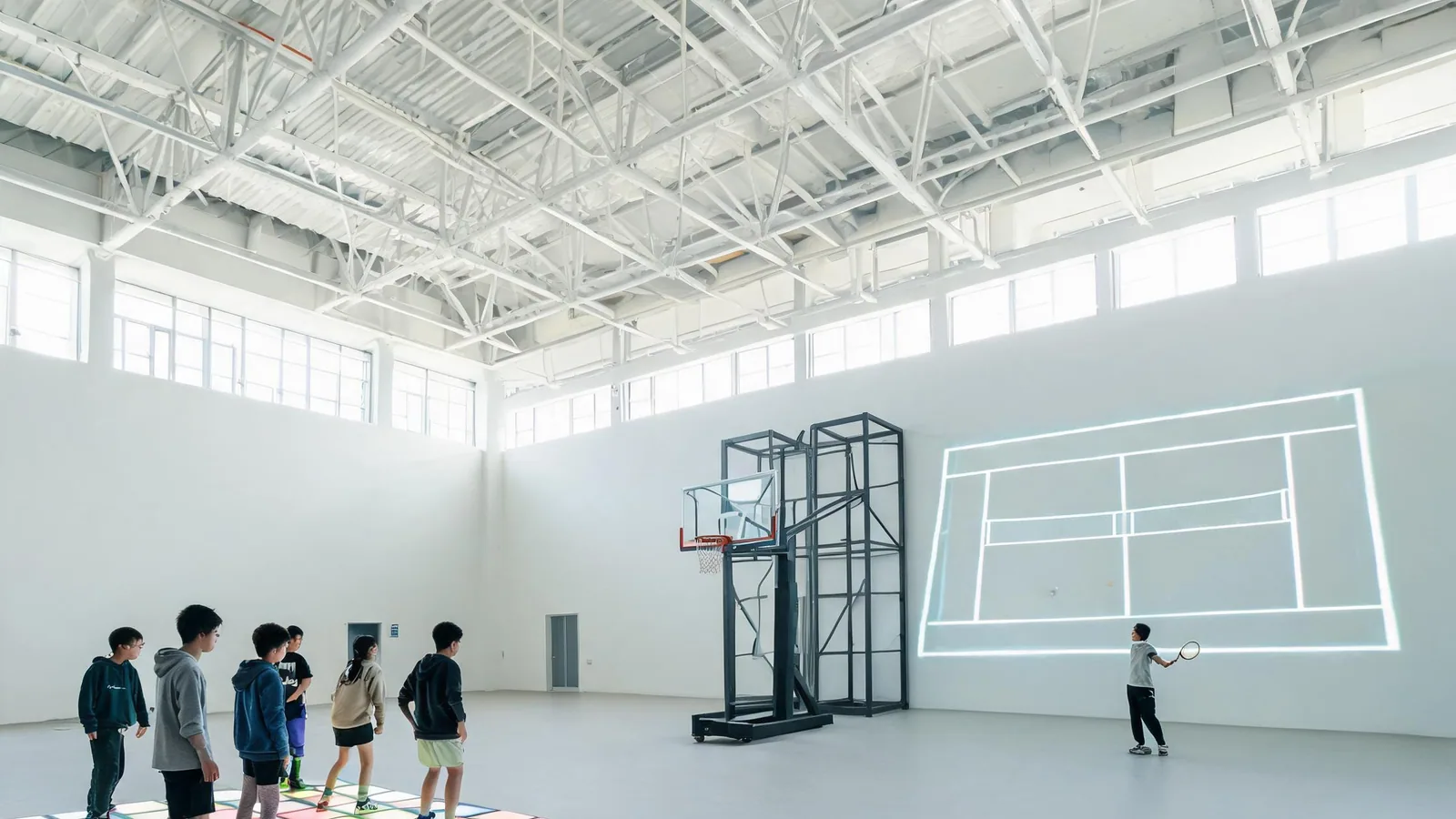
Start with Why: Why a Sports Park Needs a Digital Sports Venue
The facility mix of a traditional sports park has an obvious weakness: it is mostly outdoors and at the mercy of the weather. On rainy days, in summer heat, and in winter cold, courts sit empty and trails go quiet — the hours in a year when the park is truly well used are discounted. As an indoor or semi-indoor all-weather facility, a digital sports venue turns "the days you cannot exercise outdoors" into the park's traffic peak — when every other facility is idle, it runs at full load. That is its first contribution to the park's overall revenue per square meter.
The second value is **all-ages coverage**. Traditional courts serve "people who already play a sport"; children, seniors, and complete beginners are excluded by nature. Digital sports equipment has an extremely low barrier: interactive projection works for a three-year-old, simulated basketball requires no dribbling skill, and motion-sensing games welcome elderly players. A sports park that genuinely serves fitness for all must give "people who don't play sports" something to play too.
The third value is the most practical: **operating revenue**. Tickets, multi-visit cards, training programs, tournaments, and team-building packages make the digital sports venue one of the few facilities in a park that can legitimately charge fees. That income subsidizes the upkeep of free facilities and renews landscaping and lighting, moving the park into a positive cycle of "the venue sustaining the park" — far more sustainable than applying for fiscal funding alone.
- All-weather facility: turns bad weather into the park's traffic peak
- All-ages coverage: gives non-athletes something to play
- The venue sustains the park: operating income feeds back into free-facility upkeep
Visitor Mix: Nearby Families Are the Base, Schools and Team Building Are the Growth
A sports park digital venue's visitor base radiates outward from the park itself. **The base is families within three to five kilometers**: parents bringing kids to burn energy after dinner, families planning a half-day weekend outing — high frequency, low spend per visit, price-sensitive. They are the main buyers of multi-visit and monthly cards, and the visitors most likely to form a habit around the park.
**The second tier is teenagers and schools**: after-school programs, sports field trips, and holiday training camps at nearby primary and secondary schools need equipment that supports grouping, scorekeeping, and measurable progress. This demand concentrates on weekday afternoons, neatly filling the trough before family visitors arrive. **The third group is corporate team building**: a pleasant park setting with convenient parking, plus a venue that can host group competition, is a cost-effective choice for local companies.
One easily overlooked group is **the seniors who exercise at dawn**. They are the absolute majority on park grounds on weekday mornings; bored with traditional fitness equipment, they are highly receptive to motion-sensing exercise and interactive rehabilitation devices. Free or reduced public hours for them both implement the fitness-for-all policy and bring them back later with grandchildren as paying customers — senior hours build foot traffic, family hours build revenue, and the two lines do not conflict.
- Base: families within 3–5 km, high frequency and low spend, buying multi-visit cards
- Growth: school programs fill weekday afternoons, team building fills the rest of weekdays
- Senior morning exercise builds traffic, family hours build revenue — both run in parallel
Where the Space Comes From: New Amenity Buildings, Under-Stand Areas, and Idle Space
New sports parks are the simplest case: include the venue as **an amenity service building** in the master plan from the design stage, filed for approval together with parking, restrooms, and management offices. Location follows two principles — close to the main entrance or a major pedestrian node (to guarantee natural walk-ins), and a moderate distance from parking (families carrying kids and gear show a clear drop-off in arrival rate once the walk exceeds five minutes).
For existing parks, the first priority is **the open space beneath grandstands**: stadium and gymnasium stands often hide large idle areas with ready ceiling height for cabling and minimal construction work. The second source is **idle buildings and management rooms**: underused old exhibition halls, vacant warehouses, and failing tea houses cost far less to convert than to build new, once daylighting, ventilation, and fire approval are solved. The third is **enclosing canopies and corridors**: adding enclosures and climate control to semi-outdoor all-weather courts and covered walkways turns them into semi-indoor sports zones at the lowest cost — right for tight budgets.
Evaluate every candidate site against five hard conditions: **ownership and land use** (for a commercial project on park land, confirm the compliance path with the landscaping and sports authorities first), **ceiling height and load-bearing** (large equipment has clear-height and floor-load requirements), **water and power capacity** (total equipment wattage decides whether you need a capacity upgrade), **fire code** (occupancy determines evacuation requirements), and **noise** (for sites near residences, cheering and machine sound must be isolated at the design stage). Fail any one condition, and change the site before talking about equipment.
- New builds: included as amenity buildings, near the main entrance and parking
- Existing parks: under-stand areas and idle buildings first — least construction work
- Five hard conditions: land use / height & load / utilities / fire code / noise
Equipment Selection: Weather-Resistant, Low-Maintenance, All Ages
The biggest difference between a park setting and a mall venue is **usage intensity and environment**: traffic peaks concentrate in evenings and weekends, so each machine cycles many more times per day, and semi-outdoor spaces test equipment with temperature swings, humidity, and dust. The first selection principle is **durability and low maintenance** — prefer simple mechanical structures, commonly available wear parts, and remote fault diagnosis. Flashy high-precision machines see their maintenance costs spiral under heavy use.
The second principle is **an all-ages mix**. A park's visitors span from toddlers to seniors, so the equipment mix works in three layers: interactive projection and motion games for young children, competitive battles and simulated ball games for teenagers, and simulated sports plus gentle motion devices for adults and seniors. A venue skewed to one layer pushes every other group back to the free facilities, and the paid zone never takes off.
The third principle is **matching the park's character**. Equipment styling should lean athletic, not arcade — a sports park's credibility rests on "this is sports equipment, not a game parlor," so appearance, naming, and signage must all point toward sport and health. Self-service terminals (drink machines, lockers, self-service ticket kiosks) belong at the entrance, reducing staffed points and fitting the park's reality of dispersed management.
- Durability and low maintenance first: simple structure, common wear parts, remote diagnosis
- Three-layer mix: motion play for kids / competition for teens / simulated sports for adults and seniors
- Athletic styling and signage; self-service terminals reduce staffed points
How to Tier Area and Investment
A sports park venue's area follows the park's grade and service population. **Small (300–800 square meters)**: the choice for community-level and pocket parks — eight to twelve machines, watchable by a single staff member, positioned as "the park's indoor complement," with modest investment and a short decision chain, ideal for district-level projects proving the model first. **Medium (800–2,000 square meters)**: the mainstay configuration for city-level sports parks — fifteen to twenty-five machines with clear zoning (young-kids area, competition area, rest area), able to host school bookings and corporate team building, and starting to need a dedicated operations team.
**Large (2,000 square meters and above)**: a standalone venue at the urban sports center level — thirty-plus machines with training classrooms, a tournament area, and a light-meal zone, operated on full venue logic, usually filed in combination with functions such as the sports authority's fitness-for-all center or youth sports-skills training center.
Run the investment estimate through a tool first: input your scenario, area, and city tier to get reference values for the equipment list, investment range, operating-cost share, and capital-recovery window. On funding, park projects have more paths than commercial ones: fitness-for-all special funds, sports lottery public-welfare funds, and public-private partnerships (an enterprise invests and operates; the park provides the site and brand endorsement). Different models demand different capital-recovery expectations — fiscal money looks at social benefit, private money looks at operating data, and your plan must keep both sets of books straight.
- Three tiers: community complement / city mainstay / standalone sports-center venue
- Run the range through the calculator first, then set the tier by park grade
- Diverse funding: special funds / lottery welfare funds / PPP — keep both sets of books straight
Pricing Model: Balancing Public-Welfare Hours and Operating Hours
The most common cause of death for a park venue is unclear pricing design: fully free, and maintenance fails to keep up so the venue decays fast; fully paid, and you are accused of occupying public resources. The correct answer is **time-slot splitting**: weekday mornings become public-welfare hours with reduced or free admission for students, seniors, and people with disabilities — this is the "free or reduced opening" the fitness-for-all policy requires, and the compliance basis for applying for funding support. Evenings, weekends, and holidays become operating hours at full price, pushing multi-visit and monthly cards.
**Price anchors follow the park's visitor base**: set single-visit tickets in the "no hesitation" range for families, give multi-visit and monthly cards a visible discount to lock in high-frequency visitors, offer student discounts with ID and free admission in senior welfare hours — every price tier must be explainable in one sentence. All tickets and cards are redeemed through the system, and the welfare-hour traffic data is itself an asset: when applying for operating subsidies or special funds, service visits are the hardest proof you can present.
Bowlanding Ant's Venue Smart Management System (¥58,000) covers five modules: ticketing, membership, tournaments, loyalty points, and analytics. Welfare-hour and operating-hour pricing strategies are configured in layers inside the system, with QR-code entry and automatic redemption; service visits, time-of-day distribution, and repeat-purchase data all accumulate — supporting daily operations while directly generating the fitness-for-all service reports you submit to the authorities.
- Time-slot splitting: free or reduced welfare hours on weekday days, full-price operations evenings and weekends
- Every price explainable in one sentence; all tickets redeemed in-system
- Welfare-hour traffic data is an asset for subsidy and funding applications
Connecting with the Park Ecosystem: Cross-Promoting Courts, Trails, and Playgrounds
The venue is not an island inside the park — its biggest dividend is **cross-promotion with the free facilities**. When designing circulation, make the venue entrance intersect the main loop connecting the courts, playground, and fitness trail: families coming to play ball walk past and the kids want in; seniors out for a stroll drop in along the way. The wayfinding system should fold the venue into the park's overall map rather than hanging a standalone sign.
**Joint tickets and mutual privileges** are step two: venue spending points can be exchanged for parking discounts and court-booking priority; players in the court league get venue trial vouchers in their player packs; playground tickets bundle with venue parent-child passes. None of this needs a complex system — one membership-points framework runs it all. The point is to give every type of park visitor a chance to convert into a venue customer.
**Co-hosted events** are step three: when the park runs a fun run, set the finish-line carnival at the venue; on National Fitness Day, make the venue the indoor sub-venue; at summer evening gatherings, use the venue's tournament projection as the backdrop. A park only hosts a handful of big events a year, and each one is a low-cost acquisition window for the venue — riding the park's event traffic beats paying for your own promotion.
- Circulation intersection: entrance on the main loop, wayfinding folded into the park map
- Mutual privileges: points for parking and court benefits, tickets bundled together
- Co-hosted events: every park event is an acquisition window for the venue
School Partnerships and Community Tournaments: Turning Traffic into a Calendar
A park venue's steadiest B-side customer source is **nearby schools**. The after-3:30 care gap, rainy-day backups for PE classes, and holiday sports camps are all rigid school needs. The key to closing a partnership is giving the school a plan it can defend: complete equipment-safety certifications, recorded and quantifiable results, and a summary report issued after the event — what a school wants is not fun but compliance and traceable safety.
**Community tournaments** turn a park venue from "pay per visit" into "check in monthly." The system need not be complex: small daily events keep activity up (shooting challenges, motion jump-rope leaderboards), monthly events build rankings (points tables and tiers), and quarterly flagships create buzz (family sports meets, neighborhood rivalry games). Registration, timing, and points all run through the system; prizes come from the park's own resources — free court hours, parking vouchers, venue multi-visit cards — at marginal cost.
The real value of tournaments is **calendarization**: when nearby families know "the park hosts a competition on the second weekend of every month," visits turn from random into planned. Tournament data feeds operations too — which event fills up fastest and which time slot draws the most participation directly guide equipment rotation and event scheduling. For schools and the community, a venue that keeps hosting tournaments is also their own achievement and benefit; with all three sides getting what they need, the relationship lasts.
- School partnerships hinge on compliance: safety certifications, score records, activity reports
- Three tournament tiers: daily activity / monthly rankings / quarterly buzz
- Calendarized tournaments turn random visits into planned ones
Staffing by Reuse: Start with Park Office Staff in Shared Roles, One Dedicated Position Only
A small or mid-size park venue needs no standalone team — **the park management office's existing staff in shared roles** can run it: ticket sales and redemption are handled by gatekeepers or the service desk (QR redemption follows the same flow as the park's annual pass), cleaning is covered by the park's existing sanitation line, and security patrols fold into the park's established routes. The only position that must be dedicated is **the venue attendant**: opening and closing, daily equipment checks, visitor guidance, and emergency response — one person per shift covers a small or mid-size venue.
The precondition for shared roles is likewise **standardization**: each machine's safety instructions, the steps for common faults, and the daily opening and closing checklists are each written on a single page posted in the operations room. When new equipment arrives, the manufacturer's engineer delivers training, and the park names one or two equipment owners as long-term contacts with the manufacturer. Training records are kept on file — park projects are inspected often, and certifications plus training records are fixtures of compliance audits.
Scheduling follows the park's traffic rhythm: one attendant during weekday welfare hours, an added guide during evening operating hours, full staffing on weekends and holidays with extra on-floor supervision. Volunteers are a resource unique to the park setting — community-recruited sports instructors and university students on social-practice placements can, after basic training, handle order keeping and assist with young-child supervision, cutting costs while strengthening community involvement.
- Shared roles to start: gatekeepers redeem, cleaning rides along, security patrols cover
- The only dedicated position: the venue attendant — one person per shift
- Volunteers fill supervision and order-keeping gaps at low cost while building community involvement
Safety and Maintenance: Red-Line Management Under Heavy Use
A park venue's usage intensity far exceeds a commercial venue's: a machine running continuously for a dozen-plus hours on weekends is normal, and users include large numbers of children and seniors, so safety standards must follow the strictest version. **Equipment safety**: corner guards, soft padding, and emergency stops are checked item by item before opening each day; the young-kids area sits where supervision sightlines are unobstructed; safety instructions use icons plus large type so pre-literate toddlers and elderly visitors with fading eyesight can both understand.
**Electrical and fire safety** are inspection priorities for park projects: total equipment wattage matches line capacity, distribution boxes are locked and labeled with a responsible person; semi-outdoor equipment gets moisture and sun protection, with a special inspection before the rainy season; extinguishers, emergency lighting, and evacuation signage are provisioned to occupancy and checked on schedule — these are not costs but the license that lets the project operate for the long term.
**Maintenance cadence binds to traffic**: a power-on self-check before opening each day, structural inspections weekly, deep servicing monthly — all logged in the management system's service module. A failed machine gets an "out of service" sign and a same-day repair ticket; never let visitors keep playing a broken machine — in a park setting, the reputational damage of "broken equipment nobody fixes" transfers directly to trust in the park's management. After traffic peaks (long holidays, end of summer vacation), schedule one concentrated overhaul and replace wear parts together.
- Strictest safety: guards and emergency stops checked daily; instructions in icons and large type
- Electrical and fire safety are the license: matched loads, moisture and sun protection, scheduled checks
- Failures signed and reported same day; concentrated overhaul and wear-part replacement after peaks
Rollout Cadence: From Single-Venue Validation to Network Replication
Roll out a sports park venue in three phases. **Phase one (months 1–6)**: pick one park and one space of 300–800 square meters, install eight to twelve all-ages machines, and prove the "welfare hours + operating hours" pricing model — the core is validating three metrics: operating-hour utilization, multi-visit and monthly card conversion, and welfare-hour service visits. One quarter of on-target data, and the model is proven.
**Phase two (months 6–12)**: expand to mid-size, complete the zoning and training classrooms, land school partnerships and a monthly tournament calendar, and connect every module of the management system — service visits and operating revenue both enter the park management's monthly reports. This phase completes the shift from "one venue" to "one operating system," and staffing transitions from shared roles to a dedicated team.
**Phase three (year one onward)**: rotate equipment on quarterly data and evaluate upgrading into an urban sports center; more importantly, **export the model** — package the proven pricing model, partnership frameworks, and operating standards into a plan and replicate it across other parks in the city. A sports park is a networked asset: the value of validating one venue is ultimately realized through replication.
- Phase one validates three metrics: utilization / card conversion / welfare service visits
- Phase two builds the system: zoned expansion + school partnerships + tournament calendar
- Phase three exports the model: replicating single-venue standards across the city's park network
FAQ
Is it compliant to build a commercial sports venue inside a sports park?
The compliance path is clear: at the planning stage, include the venue in the master plan as a park amenity service building for approval; for conversions of existing space, confirm the site's land use and operating authorization with the landscaping and sports authorities. The "venue sustaining the park" model — where operating income feeds back into park maintenance — does not conflict with the free-or-reduced opening policy, provided welfare hours and operating hours are clearly split and the accounts are auditable.
What is the right size?
Tier it by park grade: community parks take 300–800 square meters (8–12 machines) as an indoor complement; city sports parks take 800–2,000 square meters (15–25 machines) as the main operating unit; above 2,000 square meters, plan a standalone urban sports center venue. Run the investment range through the calculator against service population and city tier first, then set the tier.
Will charging admission in a free park draw complaints?
Time-slot splitting defuses it: weekday mornings are welfare hours with free or reduced admission for students, seniors, and people with disabilities; evenings, weekends, and holidays are full-price operating hours. The welfare-hour service-visit data is itself proof material when applying for fitness-for-all subsidies. Post the rules at the entrance and on the price list — most complaints come from "it wasn't explained," not from the charging itself.
Can digital sports equipment be used in semi-outdoor spaces?
Yes, but selection matters: prefer weather-resistant models with proper moisture, sun, and dust protection; simple mechanical structures with commonly available wear parts suit high-intensity use; run a special electrical inspection before the rainy season. During extreme weather (typhoons, severe cold), shut down per the contingency plan and cover that downtime gap with indoor-equipment revenue.
Do we need a dedicated operations team?
Not at small or mid-size. Ticket sales and redemption are handled by the park service desk, cleaning and security fold into the park's existing lines, and the only dedicated role is the venue attendant (opening and closing, daily equipment checks, visitor guidance, emergency response — one person per shift). Add guides and supervisors on weekends and holidays; trained community volunteers can assist with order keeping.
How do we approach schools about partnerships?
Schools want compliance and traceable safety: complete equipment-safety certifications, recorded and quantifiable activity data, and a summary report issued after the event. Enter through three rigid scenarios — after-school care, rainy-day PE backups, and holiday camps. Offer one free trial session so the school sees your organizational capability, then negotiate a semester package price.
What if equipment breaks and repairs cannot keep up?
Three lines of defense: at selection, prefer simple mechanical structures, commonly available wear parts, and remote-diagnosis support; day to day, follow the "daily self-check, weekly inspection, monthly service" rhythm with records kept; a failed machine gets signed out of service and reported for repair the same day, with a designated equipment owner liaising with the manufacturer long-term. After traffic peaks (long holidays, summer vacation), schedule one concentrated overhaul and replace wear parts together.
What use is operating data to the park management?
Three direct uses: welfare-hour service visits are hard evidence for fitness-for-all special funds and operating subsidies; time-of-day and visitor-mix distribution guides the park's overall event scheduling and facility planning; and operating revenue plus traffic data are the decision basis for proving to superiors that "the venue sustaining the park" works and deserves replication to other parks. The data accumulates in the management system and monthly reports generate automatically.
How long before we know whether the model works?
One quarter. Watch three metrics: operating-hour utilization (the share of time machines actually run), multi-visit and monthly card conversion (trial visitors becoming cardholders), and welfare-hour service visits. If all three hit target, the cycle of "welfare hours building traffic, operating hours building revenue" holds and you can expand and replicate; if not, adjust pricing and the equipment mix first — do not rush to build more.
RELATED
 Digital Sports Zone Planning & Operations Guide for Hotels and Resorts
 Space Design & Circulation Planning for Digital Sports Venues
 End-to-End Digital Sports Equipment Procurement Guide
 Indoor Digital Sports Venue Investment & Opening Guide
 Digital Sports Venue Operations & Repeat Purchase Playbook
 Digital Sports Park Implementation for Cultural Tourism
 Equipment Safety & Maintenance Management Guide
 Customer Acquisition & Local Marketing for Digital Sports Venues
CONTACT
Send Us Your Park Site Plan
Tell us your park grade, available space, and service population, and we can offer reference recommendations on venue tiering, equipment mix, and the welfare/operating hour split.
2026-11-11