
INVESTMENT & OPERATIONS GUIDE
Indoor Digital Sports Venue Investment Guide
A practical guide to planning an indoor digital sports venue: site assessment, audience positioning, equipment mix, investment structure, opening operations and after-sales support.
An indoor digital sports venue combines sport, play and social interaction in one space that guests can visit again and again. It does not depend on outdoor weather, and it is not limited to the single-purpose machines of a traditional gym. That is why it is becoming a useful traffic driver for shopping malls, neighbourhood retail and tourism projects.
This guide follows the real project sequence: site assessment, audience positioning, equipment mix, investment structure, design and construction, opening preparations, operations and maintenance. It avoids blanket price lists, because floor area, city, equipment selection and lease terms change the numbers significantly. Final figures should always come from an on-site survey and a confirmed equipment list.
Start with demand: what an indoor digital sports venue actually solves
Traditional sports venues face a familiar set of problems: limited equipment, low repeat visits and revenue that depends on memberships. An indoor digital sports venue turns movement into a scored, competitive and shareable experience. Guests stay longer, arrive in groups more often, and the average spend becomes easier to lift through combination tickets, memberships and events.
For commercial property, the format also works as a footfall and dwell-time engine. Families, students and young professionals each find something to do in the same building, while tourism sites gain a reliable option for rainy days and evening hours.
- Families: parent-child play, birthday parties and weekend outings
- Students and young adults: competition, challenges and social sharing
- Companies and schools: team building, sports classes and themed events
- Property and tourism: footfall, longer dwell time and night-time activity
Site assessment: understand the space before choosing equipment
Site selection sets the ceiling for the whole project. Look at three groups of factors: a sustainable source of visitors, the physical condition of the space, and the fit between lease terms and operating costs. Footfall is not only about nearby population; it also depends on weekday and weekend patterns, complementary neighbouring businesses and how easily guests can reach the site.
Physical conditions are often underestimated. Ceiling height affects large interactive equipment and projection lighting; floor load and levelness affect equipment foundations; power capacity, network coverage and fire evacuation determine whether the venue can open on schedule. Complete an on-site survey before signing and record usable area, column grid, ceiling height, entrances, electrical distribution and drainage.
On the lease side, look beyond the rent per square metre. Rent-free periods, annual escalation, responsibility for building works and early-termination costs all matter. For a format that depends on regular content updates, a very short lease can cut the payback window too narrowly.
- Ceiling height, column grid and usable area
- Floor load, levelness and slip resistance
- Power capacity, low-voltage systems and network coverage
- Fire evacuation, entrances and guest circulation
- Lease length, rent-free period and escalation clauses
Audience positioning and equipment mix: give every square metre a purpose
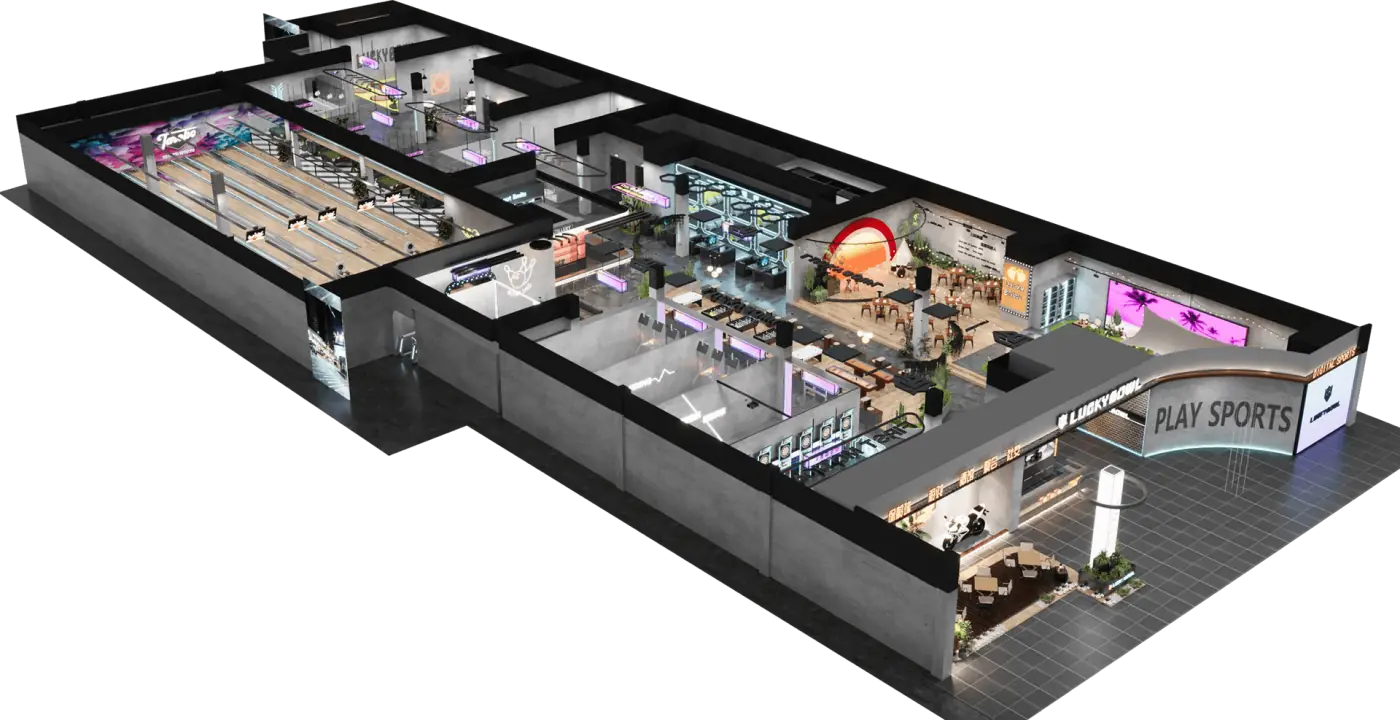
More equipment is not automatically better. A strong mix is layered by audience and dwell time. A common approach is to divide the floor into an attraction zone, a main-play zone, a competition zone, and a rest and spend zone. Near the entrance, place visually striking equipment with short sessions that pull people in. In the middle, place team-based and leaderboard-driven equipment that extends the visit. At the back, place higher-value or bookable experiences that lift the average ticket.
Families care about interaction, safety and parent-child cooperation. Young adults respond to head-to-head play, rankings and shareable moments. Corporate and school groups need activities that can be divided into teams, scored and managed consistently. The mix should be a deliberate trade-off around the target audience, not a showroom copied into the venue.
Leave room for content refresh. Digital sports equipment can be updated, so if the layout already includes replaceable modules and interfaces, seasonal themes, tournaments and co-branded events become much easier later.
Browse application scenariosInvestment structure: spend where repeat visits are created
Investment usually falls into four parts: equipment, interior fit-out and environment, rent and deposit, and opening plus working capital. They are not divided equally. Equipment sets the ceiling for gameplay, fit-out creates first impressions, rent sets fixed costs, and working capital determines whether the venue can survive the opening ramp-up.
A common mistake is to put most of the budget into equipment while underestimating fit-out, installation and commissioning, staff training and launch marketing. Equipment arriving on site is only the beginning. Power-up, integration testing, trial play, circulation adjustments and staff training all take time and budget.
A safer sequence is to define the target audience and ticket structure first, then work backwards to the equipment list and fit-out standard, and finally keep a contingency reserve for schedule changes and opening cash flow. The right percentage depends on local rent and labour costs; it should be calculated rather than copied from another city.
Any single price list is too rough for a real project. Area, ceiling height, equipment count, installation difficulty and transport distance all change the final number. Use an itemised list based on the on-site survey.
Understand the delivery processDesign and construction: circulation matters more than decoration
The design stage must solve three things at once: how people enter, how they play, and why they would come back. The entrance should communicate what can be played within a glance. Ticketing, storage, shoe changes and safety notices belong at the start of the route. Enough waiting and viewing space should be left between equipment to prevent congestion.
Safety design should come first: equipment guarding, floor cushioning, sharp-edge treatment, emergency stops and evacuation signage must be confirmed at drawing stage. For height, speed or contact-based activities, define height, weight and health notices, and set management rules that staff can actually enforce.
During construction, the equipment supplier and fit-out contractor should confirm base conditions and the sequence of works together. If equipment foundations, power points, network points, lighting and audio are adjusted after the fit-out is finished, the rework cost rises sharply.
- Entrance recognition and ticketing flow
- Equipment spacing, waiting and viewing areas
- Safety guarding and evacuation signage
- Power, network, lighting and audio points
- Delivery sequence and coordinated construction plan
Opening preparations: serve the first guests properly
Opening is not simply unlocking the door after equipment installation. At least four things should be ready in advance: staff training, ticketing and membership systems, a trial run, and launch communication. Staff need to know how every machine works, what common faults look like and which safety rules apply. Ticketing should support single tickets, combination passes, stored-value memberships and group bookings.
A trial run should involve real guests, not only an internal demonstration. Record where people stop, which activities create queues and which rules need repeated explanation, then adjust equipment positions, prices and signage. Feedback collected during the trial is usually cheaper than fixing problems after opening.
Launch communication should focus on experiences people can see, not abstract slogans. Short videos of real competitions, parent-child play and group gatherings, combined with local lifestyle platforms, community groups and neighbouring businesses, create a stronger first wave of word of mouth than discounts alone.
Review service and operations supportOperations and repeat visits: content refresh is the long game
Revenue usually comes from tickets, memberships, group activities, events and ancillary spending. Relying only on tickets leads to price competition. What stabilises the business is the member relationship and a social scene that can be repeated.
An operating rhythm can be designed in three layers: weekly, monthly and quarterly. Refresh leaderboards and challenges every week, organise themed nights or family activities every month, and update content or gameplay every quarter. Giving returning guests something new is more efficient than constantly acquiring new ones.
Use data for decisions: equipment utilisation, average dwell time, repeat rate, share of group bookings and complaint types all inform the equipment mix and pricing. Without data, operations rely on guesswork.
- Weekly: leaderboards, challenges and community interaction
- Monthly: themed nights, family activities and corporate bookings
- Quarterly: gameplay updates, tournaments and partnerships
- Annually: equipment servicing, content upgrades and membership review
Maintenance and after-sales: keep downtime to a minimum
Equipment is a long-term asset, and maintenance starts on day one. Daily checks cover fasteners, sensors, displays, lighting and network connections. Consumable parts should be stocked, and software plus content should keep a rollback version.
When choosing a supplier, look beyond the hardware. Ask about the warranty, remote diagnostics, spare-part availability, ongoing system and gameplay updates, and the engineer attendance commitment. After-sales capability directly affects the venue reputation and repeat visits.
A simple equipment register and fault log helps the team identify recurring issues quickly and makes necessary replacements or upgrades easier during the warranty period.
Learn about our brand and commitmentsA decision checklist for investors
Before signing a lease or placing an equipment order, confirm each item below. Any unanswered item represents an unpriced risk in the project.
- Who is the target audience, and what drives weekday versus weekend visits
- Do ceiling height, floor load, power, fire safety and network meet the equipment requirements
- Does the mix cover attraction, main play, competition and higher-value experiences
- Does the budget include fit-out, installation and commissioning, training and launch marketing
- Are ticketing, membership and group booking systems ready
- Are warranty, spare parts, remote diagnostics and content updates clearly defined
- Is there a workable operating rhythm and a data review routine
FAQ
How much space does an indoor digital sports venue need?
It depends on the equipment mix and target audience. A small community venue can focus on a few high-frequency interactive machines, while a mall-based venue usually needs separate zones for attraction, main play and group activities. Define the equipment list and circulation first, then fit it to the available area.
What does the investment roughly include?
Investment covers equipment, fit-out, rent and working capital. The total varies widely with area, city, equipment count and installation conditions. We do not issue blanket quotes; the equipment list and investment framework follow an on-site survey.
How long does it take to recover the investment?
Payback depends on footfall, ticket price, rent and operating efficiency. There is no fixed answer that applies to every project. Model conservative visitor numbers and reserve working capital for the opening ramp-up.
Can I operate without previous experience?
Yes, but operations should be treated as professional work. Suppliers can support planning, installation, training and after-sales. The investor still needs a local team and basic processes for ticketing, membership, events and safety.
What happens when equipment breaks down?
Equipment carries a one-year free warranty. System content is maintained regularly, and new gameplay is updated free for both new and existing venues. Spare parts are stocked, with remote diagnostics and engineer attendance available. Response times follow the service terms.
How should I choose an equipment supplier?
Check four things: equipment reliability and safety design, delivery experience, after-sales response and content update capability. A low machine price can lead to much higher maintenance and downtime costs after opening.
CONTACT
Send us your site details
Share the area, ceiling height, city and target audience. We will propose an equipment mix and an investment framework.
2026-10-31