
Investment & payback modelling
Digital Sports Venue Investment Guide: Cost to Open and Payback
How much does it cost to open a digital sports venue? This guide gives area and investment ranges for six scenarios — shopping mall, tourism attraction, sports park, hotel resort, education science centre and arcade/FEC — breaks down equipment, fit-out, rent and working capital, explains how payback period should be calculated, and lists the five most common budget mistakes plus the right order of investment decisions.
The first question almost every client asks is how much it costs to open a digital sports venue. There is no single answer: the same 1,500 sqm on the sixth floor of a prime mall and on the ground floor of a community retail block can differ by more than double, and the difference is driven not by equipment but by rent, building conditions and tenant mix.
This guide splits investment into four discussable blocks — equipment, fit-out, rent and deposit, working capital — gives reference ranges for six scenarios, then explains how payback period should actually be calculated and the five most common budget mistakes. All ranges are bands from delivered projects of comparable size, not quotations.
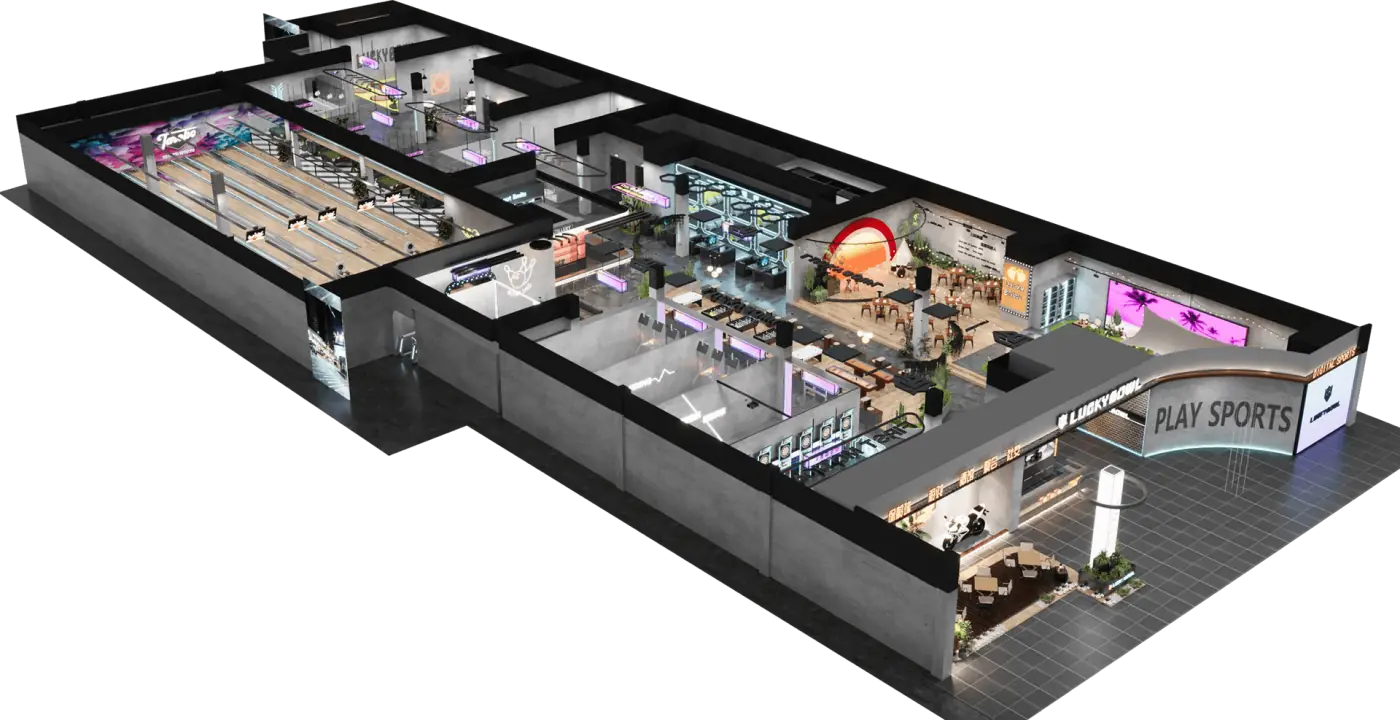
Area and investment ranges across six scenarios
The investment range on each scenario page is essentially area multiplied by equipment density multiplied by rent per square metre. Area sets total equipment volume, density sets equipment spend, and rent sets cash pressure. They are not linear: doubling the area rarely doubles equipment spend, but rent and fit-out rise sharply.
Read together, the six scenarios point to a clear conclusion: **the smaller the footprint and the closer it sits to community or existing space, the lower the investment per square metre and the faster the payback**. Larger, destination-driven venues cost more per square metre and take longer to pay back, but have a higher revenue ceiling. The right choice depends on your site and cash tolerance, not on which type is "more profitable".
- Shopping mall 800–3,000 sqm, reference ¥3.5M–¥12M, payback 24–36 months
- Tourism attraction 1,000–5,000 sqm, reference ¥5M–¥20M, payback 36–48 months
- Sports park 500–1,500 sqm, reference ¥2M–¥6M, payback 18–24 months
- Hotel resort 300–1,000 sqm, reference ¥1.5M–¥4M, payback 24–30 months
- Education science centre 500–2,000 sqm, reference ¥2M–¥8M, payback 24–36 months
- Arcade / FEC 300–1,500 sqm, reference ¥1.5M–¥5M, payback 18–24 months
Cost structure: equipment is only about half
Equipment typically accounts for 40%–60% of total investment — the largest single item, but not the whole. Fit-out takes 20%–30%, including waterproofing, fire protection, ventilation and electrical upgrades. On upper mall floors, basements and semi-outdoor attraction sites this share rises, because load reinforcement, mechanical ventilation and anti-slip or rain protection are added.
Rent plus deposit takes 10%–20% and is the heaviest cash-flow item, usually paid three to six months upfront. Working capital for three months takes 5%–10% and covers payroll, utilities and launch marketing. Many projects budget only for equipment and then discover they cannot fund the ramp-up period.
One frequently missed fact: **equipment cost is broadly consistent nationwide, while rent differs by an order of magnitude**. That gives tier-three cities far more room to build the same equipment package at a lower total investment; conversely, prime-city projects must offset rent with higher ticket prices and visitor density.
- Equipment 40%–60%: driven by area and experience-layer mix
- Fit-out 20%–30%: fire, ventilation, load and waterproofing are the hidden bulk
- Rent and deposit 10%–20%: the biggest cash-flow pressure
- Working capital 5%–10%: three months of payroll, utilities and launch marketing
How to calculate payback properly
The usual formula is total investment divided by monthly net cash flow, and the problem is how that monthly figure is defined. Counting ticket revenue only, peak season only, or a full house only will produce an over-optimistic number. A sound approach splits annual footfall by month: weekdays versus holidays, low season versus peak, then applies realistic conversion and average ticket.
The second variable is tenant mix. Pure self-operated digital sports has high margin but a defined ticket ceiling; adding leased F&B, retail and party rooms raises ticket value and dwell time but shares away part of the margin. In delivered projects, single-floor self-operated sites pay back faster but carry more risk, while multi-floor mixed sites pay back slower with a more resilient revenue structure.
The third variable is equipment depreciation and refresh. Digital sports equipment shows clear experience decay and usually needs partial refresh at 24–36 months to sustain repeat visits. Putting that refresh budget into the financial model early is far more realistic than finding the money two years after opening.
- Model month by month across the year, never peak month times twelve
- Calculate self-operated and leased margin separately
- Build the 24–36 month refresh budget into the model from day one
Five common budget mistakes
**Mistake one: extrapolating from a single cost per square metre.** Equipment density differs by more than double between experience layers — the family layer is denser than the competitive-social layer, and the arcade layer denser than the family layer. Applying a low-density figure to a high-density layer always leaves the floor empty; the reverse always overspends.
**Mistake two: ignoring building conditions.** Above the fifth mall floor you must check goods-lift dimensions and slab loading; below the second basement you need mechanical ventilation and wider egress; semi-outdoor attraction sites need rain and slip protection. These works often exceed 30% of the fit-out budget.
**Mistake three: budgeting equipment without systems.** Ticketing, membership, tournament and loyalty systems are not included with the hardware. Without them the equipment is static display and cannot generate repeat visits or secondary spend.
**Mistake four: budgeting zero for launch marketing.** Local advertising, creator visits and cross-promotion in the first three months are essential start-up costs, typically 3%–5% of total investment.
**Mistake five: no contingency.** Construction delays, fire-compliance rectification and late equipment delivery all push actual spend up. Reserve 8%–10% of total investment as flexibility.
- Do not extrapolate total investment from one per-square-metre figure
- Building-condition works often exceed 30% of the fit-out budget
- Ticketing, membership, tournament and loyalty systems must be costed
- Launch marketing 3%–5%, contingency 8%–10%
The right order of investment decisions
Many projects run the sequence backwards: find a site, then decide what to build, then ask what the equipment costs. The order should be reversed — confirm site conditions first (area, ceiling height, column grid, loading, power, fire compliance, lease term, rent), then match scenarios to the site, then configure equipment to the scenario, and only then price it.
Site conditions set the ceiling, tenant mix sets the structure, equipment configuration sets the experience. Reverse the order and any single misstep forces rework: equipment that does not fit, equipment that fits but is not fun, or a venue that is fun but does not make money.
Before signing, complete three things: a site survey, a benchmark against delivered projects of comparable size, and a risk model that includes working capital. Only then does the investment number mean anything.
- Step 1: site survey (area, height, column grid, loading, power, fire, lease, rent)
- Step 2: match tenant mix to site conditions
- Step 3: configure and price equipment against the tenant mix
- Step 4: full model including working capital and contingency
FAQ
What is the minimum investment to open a digital sports venue?
The smallest reference size on this site is a 300–500 sqm arcade or FEC upgrade at roughly ¥1.5M–¥3M. Below that volume the equipment mix is too limited to sustain repeat visits, so it is usually better as an additional zone inside an existing venue rather than a standalone site.
Why do quotes differ so much for the same area?
Four main reasons: equipment density and model mix (the same area can hold 30 or 60 machines), building-condition works (much higher on upper floors and basements), fit-out standard (basic versus themed premium), and whether systems and installation guidance are included. A quote is only comparable when it maps to a defined configuration list.
Is an 18-month payback reliable?
18–24 months corresponds to small, high-efficiency community or existing-space conversion projects, assuming stable footfall and a sound tenant mix. These figures are modelling references, not guarantees; actual results depend on location, operating capability, local competition and rent. Stress-test with conservative footfall.
Can equipment and fit-out be phased?
Yes, and it is often recommended. A common approach is to complete the attraction and competitive-social layers first so the opening experience is complete, then add the family and arcade layers over 6–12 months as real footfall data arrives. This lowers initial cash pressure and lets actual traffic validate later configuration.
Can the calculator output be used directly as a budget?
It works as a budget framework and internal communication tool, but not as a final budget. The calculator uses a range model based on area, scenario and city tier; the final budget must be recalculated against a site survey, fit-out drawings and a specific equipment list.
CONTACT
Send us your site conditions for an investment framework
Share the city, area, ceiling height, column grid, floor level, rent and target opening date. We will return a scenario match, an equipment configuration framework and an investment range estimate.
2026-11-12