
Equipment selection & configuration
Digital Sports Equipment Selection Guide: Configuring by Experience Layer
Equipment selection for a digital sports venue is not a matter of buying a total number of machines. This guide explains what each of the five experience layers — attraction, signature, competitive-social, family and arcade — is for, gives configuration ratios for three typical scenarios, lists the hard site constraints (headroom, column grid, loading, power, depth) that filter equipment, and covers the five most common selection mistakes.
The most common mistake in equipment selection is treating the equipment list as a shopping list: fix the budget, then fill the list by price. The predictable result is too little attraction equipment, too much competitive equipment and no family offer — and once opened, the visitor mix is unbalanced: young adults come once and leave, families never come at all.
The correct approach is to fix the experience-layer structure first, then choose equipment within each layer. The five-layer structure answers why different audiences come, how long they stay and whether they return; equipment selection answers which machines deliver that for each layer. This article follows that order and adds the hard site parameters that filter equipment.
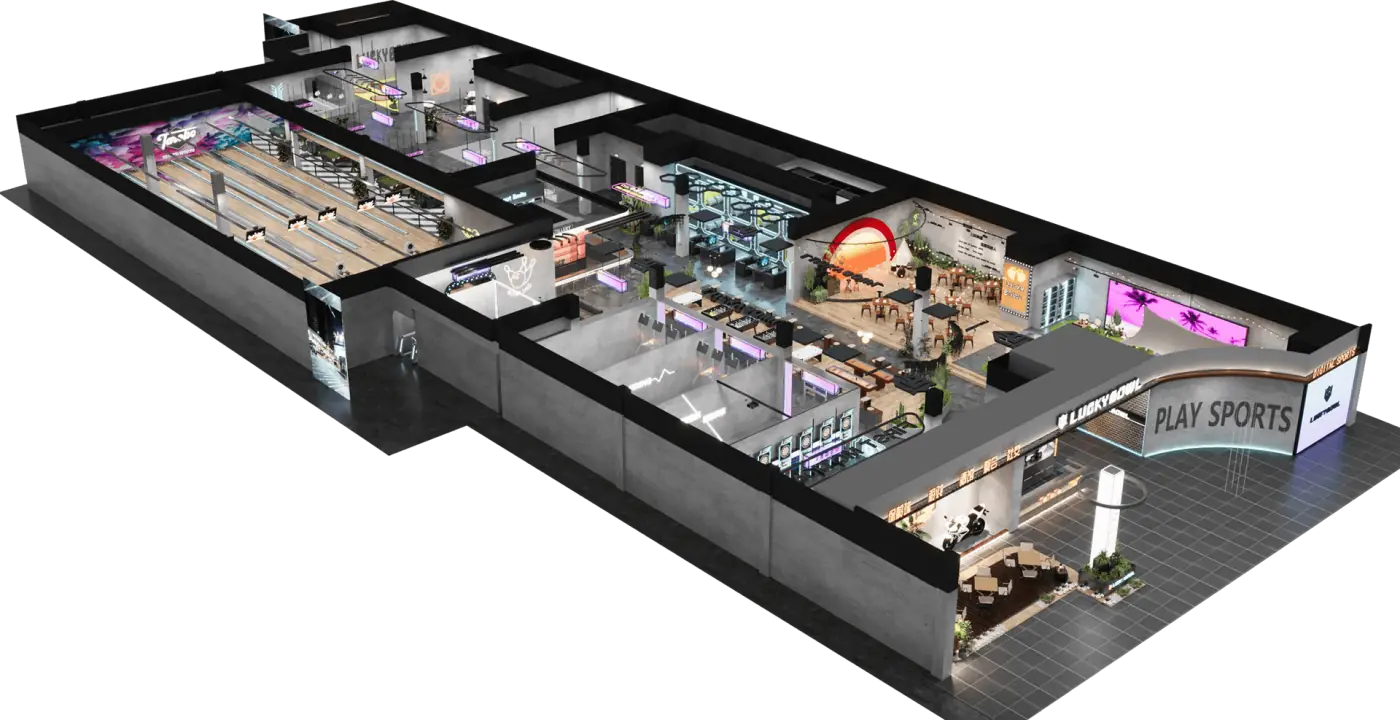
What each of the five layers is for
The **attraction layer** sits at the entrance and along the main circulation route. Its job is to stop passers-by within three seconds. Typical characteristics: strong visual impact, zero learning curve, short session length — bumper cars, trampolines, AR interactive floors. The KPI here is not revenue but entrance conversion rate.
The **signature layer** is the venue's memory point. Its job is to make people photograph it, post it and travel specifically for it. Equipment is usually large, high-value and distinctive — simulated archery, flight simulators, track theatres. One or two units are enough, but they must be the strongest visual symbol in the building.
The **competitive-social layer** drives repeat visits. Its job is to make young groups come together and come back. Characteristics: head-to-head play, leaderboards, space for tournaments — basketball machines, competitive table tennis, curling. Its operational value far exceeds its hardware value: without tournaments and leaderboards, competitive machines are just ordinary arcade games.
The **family layer** solves audience breadth and dwell time. Its job is to give parents and children, friends and families something to do together. Characteristics: low barrier, cooperative play, high safety — interactive climbing, children's trampolines, interactive sand pools. This layer directly determines weekend and holiday traffic structure.
The **arcade layer** solves revenue per square metre and average ticket. Its job is to generate steady turnover in limited space. Characteristics: small footprint, low unit price, fast rotation — redemption and amusement machines. This layer supplements cash flow; it is not the experience core.
- Attraction layer: at the entrance route, measured by entrance conversion
- Signature layer: one or two units as the strongest visual symbol
- Competitive-social layer: tournaments and leaderboards turn hardware into retention
- Family layer: determines weekend and holiday traffic mix
- Arcade layer: small footprint, high rotation, supplements revenue per sqm
Configuration ratios for three scenarios
There is no single correct ratio, but there are sensible starting structures. For a **shopping mall anchor store** the priority is attraction plus competitive plus family: roughly 15% attraction, 5%–10% signature, 30%–35% competitive-social, 25% family and 20% arcade. Mall audiences are mixed, so any missing layer loses a whole audience segment.
For an **arcade or FEC upgrade** the priority is revenue per square metre: the arcade layer can take 35%–40%, competitive-social 25%, family 20%, attraction 10% and signature 5%. The core move is to use a small number of signature machines to upgrade the "pure arcade" positioning while keeping the rest of the floor on high-rotation equipment.
For a **tourism attraction** the priority is signature experience and dwell time: signature 25%–30%, attraction 25%, competitive-social 20%, family 15% and arcade 10%. Visitors come once a year, so the proposition is "you cannot play this anywhere else", not "come back next time".
- Mall anchor: attraction 15 / signature 5–10 / competitive 30–35 / family 25 / arcade 20
- Arcade FEC: arcade 35–40 / competitive 25 / family 20 / attraction 10 / signature 5
- Tourism attraction: signature 25–30 / attraction 25 / competitive 20 / family 15 / arcade 10
Hard site constraints that filter equipment
Selection must pass the site test first, because many machines have hard spatial requirements that cannot be fixed later. **Headroom** determines whether climbing, zip lines and large projection projects are possible. **Column grid** determines whether large units can be placed and serviced. **Slab loading** determines whether heavy mechanical equipment is allowed. **Electrical capacity** sets the total power ceiling. **Depth** determines whether bowling, archery and similar projects are feasible.
Bowling is the clearest example: a standard lane needs about 26 metres including approach and ball return, with flatness and loading requirements. Many projects draw bowling into the concept and only discover at construction-drawing stage that the building depth is insufficient. Archery, flight simulators and karting have similar dimensional thresholds.
Before finalising the equipment list, build a condition-versus-equipment cross-check table: for each candidate machine, list minimum footprint, minimum clear height, loading requirement, power draw and service space, then compare each against surveyed site data. Eliminate non-compliant items rather than choosing first and modifying the building later.
- Headroom → climbing, zip line, projection projects
- Column grid → large-unit placement and service access
- Slab loading → heavy mechanical equipment
- Electrical capacity → total venue power ceiling
- Depth → bowling around 26 m; archery and karting have their own thresholds
Five selection mistakes
**Mistake one: balancing the budget by machine count.** One 40 sqm signature machine can generate the traffic and ticket value of five small arcade machines. Balancing by count dilutes the budget into "a bit of everything, nothing memorable".
**Mistake two: buying hardware without systems.** The value of competitive equipment comes from leaderboards, tournaments, ranks and points. Without ticketing and membership systems to carry them, competitive machines degrade into single-player games and retention never materialises.
**Mistake three: ignoring serviceability and spares.** Failure rate and repairability directly determine lost revenue. Ask about common spare-parts stock, response time and on-site repairability — not only the purchase price.
**Mistake four: stacking near-identical machines.** Five highly overlapping machines in the same layer means paying five budgets for one experience. Layers should be functionally complementary, not numerically padded.
**Mistake five: filling every slot at once.** Digital sports equipment shows experience decay and usually needs partial refresh at 24–36 months. Filling every position at opening leaves no room for replacement or upgrade.
- Configure by revenue per sqm and traffic contribution, not machine count
- Competitive equipment must ship with tournament and membership systems
- Write spares stock and response time into the selection criteria
- Complement functions within a layer instead of stacking numbers
- Reserve space for 24–36 month replacement and upgrades
What a selection deliverable should contain
An executable selection package should contain at least four things: an equipment list grouped by experience layer (model, quantity, footprint, clear height, power, simultaneous capacity), a floor layout including service aisles and queueing zones, a total power and slab-loading calculation, and a phased configuration plan stating what is delivered first and what triggers the next phase.
If any of these is missing, the plan will be overturned during execution. Queueing zones and service aisles are the most frequently omitted on drawings and the most frequent operational bottleneck: the first affects peak experience, the second affects daily maintenance efficiency.
If site conditions are not yet confirmed, produce a condition-sensitive selection instead: equipment plans under three headroom and two column-grid combinations, to be narrowed once survey data arrives, rather than issuing one plan and revising it repeatedly.
- Equipment list by layer (model / quantity / footprint / clear height / power / capacity)
- Floor layout including service aisles and queueing zones
- Total power and slab-loading calculation sheet
- Phased configuration plan with trigger conditions
FAQ
How many machines does a 1,500 sqm digital sports venue need?
Depending on the layer mix, typically in the range of thirty to forty units — but machine count should never be the target. A better basis is per-layer: how much floor area goes to the competitive-social and family layers, how many non-overlapping machines each layer needs, and how much footprint and service space each machine requires. Count is an outcome, not a metric.
Does bowling really need 26 metres of depth?
A standard ten-pin lane needs about 26 metres including approach and ball return; it is a hard threshold with no compromise. If depth is insufficient, consider mini bowling, shuffleboard or other rolling-ball alternatives that deliver a similar experience in far less space.
Should attraction-layer equipment be as cheap as possible?
No. The attraction layer carries entrance conversion, so visual impact and zero learning curve matter more than unit price. Cheap, low-quality entrance equipment sets the wrong expectation for the whole venue and actually reduces downstream conversion.
How do competitive machines generate repeat visits?
Through operational support: monthly leaderboards, rank systems, team tournaments and corporate bookings. The hardware is only the carrier; the tournament rhythm and social relationships are what bring people back. Confirm at selection stage whether the machine supports networked ranking and tournament modes.
Can equipment be purchased in phases?
Yes, and it is usually safer. Complete the attraction and competitive layers first so the opening experience is whole, then add the family and arcade layers over 6–12 months based on real traffic. Phasing also lets later configuration be driven by actual data rather than estimates.
CONTACT
Send us your site parameters for a selection framework
Share the area, ceiling height, column grid, slab loading, electrical capacity and target audience. We will return a layer ratio recommendation, a candidate equipment list and a condition cross-check table.
2026-11-12